



AI News Today - May 28, 2026: Big Four AI, DeployCo, and the Enterprise Services Arms Race
The two biggest stories from May that missed most daily coverage hit us at once: KPMG deployed Claude to 276,000 employees across 138 countries, and OpenAI launched a $4 billion consulting subsidiary called DeployCo. Between them, these announcements signal that the AI industry's most important structural shift is not happening in benchmarks or model releases -- it is happening in the battle for who controls enterprise AI deployment. Also this week: Cohere acquired Aleph Alpha to create a $20 billion transatlantic sovereign AI challenger, Canada ruled that OpenAI violated its privacy laws, a developer controversy erupted over ChatGPT's voice mode running on a much weaker model, and Claude Code shipped its most detailed usage analytics update yet. Here are the 11 stories for May 28, 2026.
1. KPMG Deploys Claude to 276,000 Employees -- The Largest Big Four AI Deployment
On May 19, 2026, KPMG and Anthropic announced the KPMG Digital Gateway Powered by Claude, embedding Anthropic's frontier AI directly into KPMG's core client delivery platform across its entire global workforce of 276,000 professionals in 138 countries. The alliance begins with tax and private equity clients and expands to all advisory services, with full implementation on Microsoft Azure by September 2026.
The specifics of the deployment go beyond simple "AI access for employees." Claude Cowork and Claude Managed Agents are being integrated directly into Digital Gateway -- KPMG's primary platform for client work, proprietary tools, and AI-enabled workflows. This means KPMG professionals are not just chatting with Claude. They are building agentic workflows in real time inside the platform they already use for every client engagement, shortening deployment timelines from weeks to minutes. A task that previously required multi-week engineering cycles to configure an agent for changing tax law is now generated inside Digital Gateway in under an hour.
The cybersecurity focus is notable. One of the initial deployment areas is vulnerability scanning: KPMG and Anthropic teams will use Claude to identify and remediate vulnerabilities in critical client systems. This is Project Glasswing work applied through the KPMG distribution channel -- with 276,000 professionals covering the clients of KPMG's clients, the reach is exponential. Anthropic named KPMG a preferred consultant for private equity specifically, creating a defined commercial channel for Claude deployment in PE portfolio companies.
KPMG Global Chairman and CEO Bill Thomas framed the alliance around "security, trust, and governance rather than speed alone" -- which is the right enterprise pitch in 2026. When your AI vendor is also Anthropic (the company that litigated against the DoD over autonomous weapons and published the first public AI safety framework), the governance framing is credible.
For context on how this fits alongside the PwC (276,000 professionals), Deloitte (470,000 employees), and BlackRock enterprise deployments of Claude, our AI News Today May 20, 2026 covers the broader enterprise deployment context.
2. OpenAI DeployCo: A $4B Enterprise Consulting Subsidiary
On May 11, 2026, OpenAI launched the OpenAI Deployment Company, internally called DeployCo -- a majority-owned, standalone consulting subsidiary backed by more than $4 billion in initial capital from a consortium of 19 investment firms, consultancies, and systems integrators. The lead investor is TPG. Co-investors include Goldman Sachs, Bain Capital, McKinsey & Company, Capgemini, and 14 other firms. OpenAI simultaneously announced the acquisition of Tomoro, an applied AI consulting firm whose 150 forward-deployed engineers will form the initial operational capacity.
The operating model copies Palantir's embedded engineer approach: rather than selling licenses and leaving integration to the customer, OpenAI will place its own Forward Deployed Engineers directly inside client organizations. A typical DeployCo engagement begins with a diagnostic of where AI creates maximum value, narrows to priority workflows, builds those into production systems connected to the client's existing data and tools, and delivers measurable ROI before expanding. McKinsey and Capgemini are co-investors, meaning they have economic exposure to DeployCo's outcomes -- which makes them strong referral partners rather than passive affiliates.
DeployCo is a direct response to two competitive pressures. First, OpenAI's share of the enterprise API market reportedly fell from roughly 50% in 2023 to approximately 25% by mid-2025, as Anthropic and Google made significant inroads. Second, Anthropic launched its own $1.5 billion joint venture for enterprise AI integration in late 2025. DeployCo is how OpenAI intends to reclaim the enterprise deployment layer.
The uncomfortable tension in the announcement: OpenAI's own April 2026 policy paper acknowledged that workers using AI tools might agree their productivity is rising without believing they are receiving the benefit. DeployCo is explicitly designed to increase productivity inside client organizations. The deployment engineers who implement DeployCo's workflows may, in practice, eliminate the roles of the people whose work they are systematizing. That is not unique to DeployCo, but the scale of the $4 billion investment makes the labor displacement implication concrete.
3. The Big Four AI Race: Every Major Consulting Firm Is Betting on Claude
The KPMG and PwC deployments bring into focus a pattern that has been building throughout May 2026: every major Big Four firm is deploying Claude at enterprise scale, and they are doing it in production, not pilot.
Deloitte: Claude deployed to approximately 470,000 employees globally, announced earlier in 2026. The largest single Claude enterprise deployment.
PwC: Global alliance announced May 14, 2026. Claude Code and Cowork across its global professional services workforce. 30,000 US professionals being certified. Insurance underwriting time cut from 10 weeks to 10 days. Security task time reduced by up to 70%.
KPMG: 276,000 professionals in 138 countries. Digital Gateway integration. Tax, legal, and PE focus. Preferred partner designation. Full Azure implementation by September 2026.
EY (Ernst & Young): Has not yet made an equivalent public announcement. The competitive pressure from three Big Four firms publicly committing to Claude at scale makes an EY announcement increasingly likely in Q3 2026.
Combined, Deloitte, PwC, and KPMG represent approximately 1.1 million professionals globally, all of whom will have Claude access by September 2026. These firms collectively serve the Fortune 500, the Global 2000, and most major governments. When all three Big Four firms standardize on Claude as their AI model, they are making an implicit recommendation to every client organization they serve. That is not just revenue for Anthropic. It is distribution at a scale that no amount of direct marketing could replicate.
The platform architecture powering these deployments -- Claude Cowork, Managed Agents, and MCP connectors -- is covered in our What Is Claude Cowork? The 2026 Guide.
4. Cohere Acquires Aleph Alpha -- $20B Transatlantic Sovereign AI Challenger
On April 24, 2026, Cohere (Canada) and Aleph Alpha (Germany) announced a merger -- in practice, a Cohere acquisition -- to create what they call a "transatlantic AI powerhouse" valued at approximately $20 billion. The deal is subject to Aleph Alpha shareholder and German government regulatory approval. Cohere CEO Aidan Gomez will lead the combined entity, which will be headquartered in Toronto with a European headquarters in Berlin.
The Schwarz Group, one of Aleph Alpha's major backers (owner of Lidl and Kaufland), is investing $600 million in Cohere's upcoming Series E round as part of the transaction. Aleph Alpha brings deep German public sector relationships -- the German Ministry of Digital Affairs, the Baden-Württemberg regional government, Deutsche Bank, SAP, and Bosch are existing customers. Cohere brings global LLM development capability, customers including Royal Bank of Canada, BCE, Fujitsu, and LG CNS, and $240 million in Canadian government funding.
The strategic logic is explicit: as US-China AI tensions grow and EU organizations seek alternatives to routing sensitive data through American infrastructure, a Canadian-German AI provider operating under both countries' data sovereignty frameworks becomes genuinely attractive. Canada and Germany launched a Sovereign Technology Alliance at the Munich Security Conference earlier in 2026. Cohere-Aleph Alpha is the private-sector expression of that government alignment.
My read: the $20 billion combined valuation is aspirational and built on the premise that sovereign AI commands a premium over equivalent US-hosted capability. That premise is currently holding in defense, healthcare, and public sector contracts. Whether it holds in commercial enterprise -- where cost efficiency and capability benchmarks dominate -- is less certain. The deal has the right structure. Whether the European enterprise market will pay a sovereignty premium at scale is the revenue question that will determine whether $20 billion is reasonable or optimistic.
5. Canada Rules ChatGPT Violated Privacy Law -- Overcollection, No Consent, Children's Data
Canada's Office of the Privacy Commissioner, along with provincial counterparts in Quebec, British Columbia, and Alberta, issued findings on May 6, 2026, concluding that OpenAI's methods for developing ChatGPT violated Canadian privacy laws. The investigation found three primary violations: overcollection of personal information from the public internet without proportionality assessment, lack of valid consent and transparency with people whose data was scraped, and inadequate safeguards for sensitive data including health conditions and data about children sourced from social media, blogs, and news sites.
OpenAI has committed to additional remediation steps, and the federal commissioner found the complaint conditionally resolved. However, the provincial commissioners in Quebec, British Columbia, and Alberta disagreed with the resolution and are continuing their own enforcement proceedings. The investigation was triggered by a complaint from the Canadian civil society group CAIDP in 2023 and reflects three years of investigative work.
The practical significance: this is the first national privacy authority ruling that training data collection for an AI model constitutes a privacy violation at a level that triggers remediation orders. It is not the last. The UK ICO, German DPA, and French CNIL are each conducting similar investigations. OpenAI's standard response -- that public web data is fair game for training -- is increasingly legally untenable in jurisdictions with comprehensive privacy frameworks.
For enterprises evaluating ChatGPT deployment: the Canadian ruling creates a documented compliance question for any organization subject to Canadian privacy law (PIPEDA) or provincial equivalents. Data processed by ChatGPT may be subject to challenges from privacy regulators in Canada based on OpenAI's consent framework for training data collection. Legal review before deployment is advisable.
6. ChatGPT Voice Mode Is Running on a Much Weaker Model -- Developer Backlash
A developer controversy sparked by an Andrej Karpathy tweet this week, highlighted by Simon Willison: OpenAI's ChatGPT voice mode is running on a significantly older and weaker model than ChatGPT's text interface. According to Simon Willison's analysis, the voice mode operates on a GPT-4o-era model with an April 2024 knowledge cutoff, even as the company's highest-tier paid text models like Claude Codex equivalents can autonomously restructure entire codebases.
Karpathy's observation, as summarized by Willison: "ChatGPT voice uses a model with an April 2024 knowledge cutoff. That's before basically everything that's happened in the last year of AI." The gap between what a ChatGPT Pro subscriber experiences in text (GPT-5.5 Instant or GPT-5.5) and in voice (a GPT-4o-era model) is significant and was not disclosed prominently.
OpenAI has not officially responded to the controversy. The company's voice AI strategy is caught between two constraints: real-time voice requires low-latency inference that current frontier models cannot deliver at acceptable cost, and customers expect feature parity between modalities they are paying for. The Advanced Voice Mode launched in late 2025 was supposed to close this gap. The developer reaction suggests it has not.
The broader implication for product trust: if you are paying $200/month for ChatGPT Pro expecting the latest model across all modes, and your voice assistant is running on a model that is 13+ months behind the text model, that is a product quality gap that erodes confidence. Google's Gemini Live voice mode uses Gemini 3.5 Flash -- the same latest-generation model -- which is now the competitive comparison users will make.
7. Claude Security for Enterprise: Codebase Vulnerability Scanning in Public Beta
Anthropic released Claude Security, a public beta tool for Enterprise customers running on the Claude Opus 4.7 model, that scans codebases for vulnerabilities and analyzes component interactions to identify security issues at a level of depth that static analysis tools cannot achieve.
The key differentiator from traditional security scanning: Claude Security can reason about how components interact across a large codebase -- understanding architectural vulnerabilities, privilege escalation paths, and authentication bypass patterns that emerge from the combination of multiple correct-looking code segments. Static analysis tools flag specific code patterns. Claude Security understands what the code is trying to do and whether the security model is internally consistent.
The KPMG partnership specifically includes cybersecurity work as one of the initial deployment areas. Palo Alto Networks is in the Project Glasswing consortium for exactly this capability. And the AISI evaluation of Mythos Preview showed autonomous corporate network attack simulation succeeding in 3 of 10 attempts -- meaning the same capability applied defensively can find the attack paths before adversaries do.
For the full picture of Anthropic's cybersecurity positioning, including Project Glasswing and the DoD lawsuit context, our deep dive on Claude Mythos: Release Date, Access, and What Comes Next covers the technical capabilities.
8. Claude Code v2.1.149-152: Usage Breakdown, PowerShell Security Fix, 30+ Updates
Claude Code shipped v2.1.149 through v2.1.152 over the past few days, with the latest version (v2.1.152) confirmed on May 27, 2026. The headline features in this release cluster:
- Usage breakdown in /usage: The /usage command now shows a per-category breakdown of what is driving limit consumption -- skills, subagents, plugins, and per-MCP-server costs -- so developers can see exactly which components of their agent setup are consuming the most capacity.
- Keyboard-friendly diff scrolling: The /diff detail view can now be scrolled with keyboard shortcuts (arrows, j/k, PgUp/PgDn, Space, Home/End), making it practical to review large diffs without leaving the terminal.
- Markdown GFM task list rendering: Markdown output now renders GitHub Flavored Markdown task list checkboxes (- [ ] todo / - [x] done) as actual checkboxes instead of plain bullets.
- Enterprise MCP setting: Added allowAllClaudeAiMcps managed setting to load Claude.ai cloud MCP connectors alongside managed-mcp.json for enterprise deployments.
- Security fix -- PowerShell permission bypass: A significant security fix in v2.1.149 closes a permission bypass where built-in PowerShell cd functions (cd.., cd\, cd~, X:) could change the working directory without detection, potentially allowing access outside the workspace.
The PowerShell security fix carries a security advisory. If you are running Claude Code in Windows environments with PowerShell, v2.1.149 or later is required to close the permission bypass. Update immediately with claude update or winget upgrade Anthropic.ClaudeCode.
For hands-on Claude Code integration patterns and agentic coding workflows, the gen-ai-experiments repository has working notebooks across 297 Claude Code versions.
9. The Deployment Race Is Now the Real AI Race
The KPMG + PwC + DeployCo stories this week crystallize a structural shift that has been building since Q4 2025: the competitive AI race in 2026 is not primarily about benchmark scores. It is about who controls the deployment layer -- the systems, workflows, and organizational relationships through which AI capability actually reaches end users and generates durable revenue.
The benchmark race still matters at the frontier tier. Anthropic's Claude Mythos cybersecurity capabilities, OpenAI's Erdos math proof, and Google's Gemini Omni video generation are real capability advances. But the companies generating the most revenue in 2026 are winning on distribution and deployment, not just capability. Anthropic's $10.9 billion Q2 revenue is driven by Claude Code API usage and enterprise platform contracts, not by users who chose Claude over GPT because it scored slightly higher on GPQA Diamond.
The consulting firm deployments are the clearest demonstration of this dynamic. When Deloitte (470,000 employees), PwC (hundreds of thousands of professionals), and KPMG (276,000 staff) all standardize on Claude by September 2026, the Fortune 500 companies they serve receive an implicit recommendation that Claude is the safe, governed, enterprise-grade choice. That is not a benchmark. It is a distribution channel that generates client decisions across every organization those firms advise.
OpenAI's DeployCo is the explicit acknowledgment that this competition exists. By building a $4 billion consulting subsidiary, OpenAI is not trying to win on model capability alone. It is trying to own the deployment layer independently of consulting firm intermediaries. The question is whether 150 Forward Deployed Engineers scaling to potentially thousands can match the reach of three Big Four firms with combined headcount above one million. In the near term, it cannot. Over three years, if DeployCo executes well, the answer becomes less clear.
10. What the Big Four Pattern Tells Us About Claude's Enterprise Strategy
Anthropic's Big Four strategy is not accidental. In 2026 alone: Deloitte (announced early 2026), PwC (May 14), KPMG (May 19). Three of the four largest professional services firms have committed to enterprise-wide Claude deployment within approximately 60 days of each other.
The sequencing tells a story. Deloitte was the first mover and anchor reference. Once Deloitte was public, PwC faced a competitive pressure to announce. Once PwC announced, KPMG faced the same pressure. The fourth firm, EY, now faces the most acute competitive disadvantage in client conversations where AI deployment is part of the discussion. The absence of an EY announcement becomes a competitive signal, not a neutral data point.
For Anthropic, the Big Four lock-in is a distribution compounding machine. Each Big Four firm brings not just its own employee headcount but its entire book of client relationships. The combination of deep enterprise workflows (built on Claude Cowork and Managed Agents), commercial trust (governance-first positioning), and now Big Four credibility creates a moat that is harder to replicate than a model benchmark score.
The implication for builders: if your company already uses KPMG, PwC, or Deloitte for any service line, Claude is already entering your organization through the consulting relationship, whether or not your IT team has made an explicit AI procurement decision. Understanding how Claude is being used in your advisory workflows -- and having your own API access to the same models -- is becoming a basic enterprise AI literacy requirement.
11. Looking Ahead: Microsoft Build June 2-3, Apple WWDC June 8, SpaceX IPO June 12
The biggest three-event window of the year opens in five days. Here is the updated preview:
Microsoft Build (June 2-3, San Francisco and online): Azure AI Foundry multi-model announcement expected, with Anthropic Claude officially available alongside OpenAI models. GitHub Copilot multi-agent orchestration, AI Foundry for Windows SDK, and Agent 365 audit capabilities are the developer-focused stories. Satya Nadella and Kevin Scott headlining.
Apple WWDC (June 8-12, Apple Park keynote June 8 at 10am PT): Siri 2.0 with Gemini integration, the Extensions system for third-party AI providers in iOS 27, macOS 27 stability redesign, and potentially a HomeOS preview. The Gemini-powered Siri demo is the single most-anticipated consumer AI moment of the year -- 2 billion Apple devices getting Gemini-powered AI under the hood.
SpaceX IPO (pricing June 11, trading June 12, Nasdaq SPCX): $1.75 trillion target valuation, up to $75 billion raise, 30% retail allocation via Robinhood, Fidelity, and Schwab. The Anthropic $1.25B/month compute contract makes SpaceX's AI revenue growth story directly linked to Anthropic's trajectory. The first public market data point for AI-era infrastructure valuation.
The week of June 2 to 12 is ten days that will set the AI narrative for the second half of 2026. If Microsoft Build and WWDC both deliver on their promised Gemini/Claude integration stories, and SpaceX prices successfully, the AI IPO wave narrative shifts from speculative to proven.
For the full SpaceX IPO analysis and how it links to Anthropic's compute strategy, our AI News Today May 27, 2026 has the detailed breakdown.
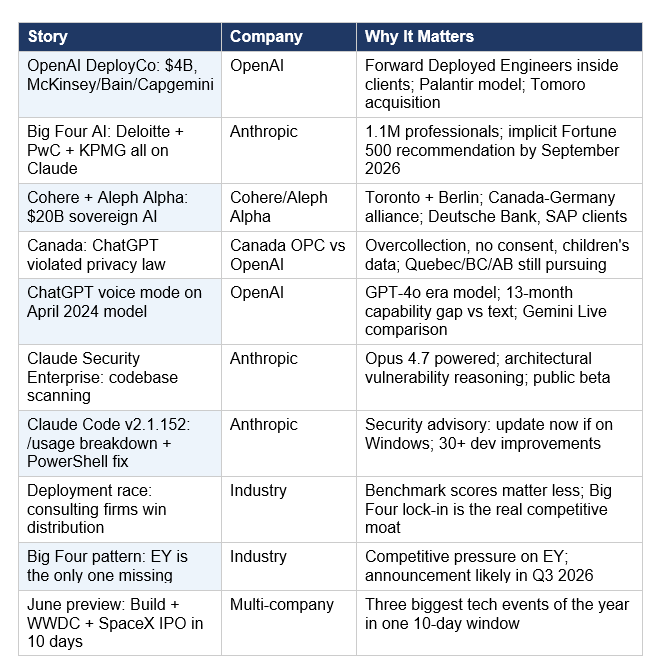
May 28 AI News at a Glance
Frequently Asked Questions
What did KPMG and Anthropic announce in May 2026?
KPMG and Anthropic announced the KPMG Digital Gateway Powered by Claude on May 19, 2026. The global alliance deploys Claude to KPMG's 276,000+ professionals across 138 countries and territories. Claude Cowork and Managed Agents are being integrated into Digital Gateway, KPMG's core client delivery platform on Microsoft Azure, initially targeting Tax & Legal clients and private equity firms. The alliance names KPMG a preferred consultant for private equity. Full Azure implementation is targeted for September 2026. KPMG will also co-develop Claude-powered products for PE portfolio companies.
What is OpenAI DeployCo?
OpenAI Deployment Company (DeployCo) is a majority-owned standalone subsidiary launched on May 11, 2026, backed by more than $4 billion in initial capital from TPG, Goldman Sachs, McKinsey, Bain Capital, Capgemini, and 14 other investors. DeployCo places Forward Deployed Engineers (FDEs) directly inside client organizations to identify AI opportunities, redesign workflows, and build production AI systems. The company acquired Tomoro, an applied AI consulting firm with 150 engineers, as its initial operational capacity. DeployCo is OpenAI's direct response to losing enterprise market share to Anthropic and Google, and to competition from Big Four consulting firms that are now aligned with Anthropic.
Why did Cohere merge with Aleph Alpha?
Cohere, based in Canada, announced the acquisition of Aleph Alpha, based in Germany, on April 24, 2026, to create a transatlantic sovereign AI company valued at approximately $20 billion. The deal gives Cohere access to Aleph Alpha's German public sector relationships (German Ministry of Digital Affairs, Baden-Württemberg government, Deutsche Bank, SAP) and complements Cohere's existing LLM capabilities with European data sovereignty infrastructure. The Schwarz Group (Lidl's parent company) is investing $600 million in Cohere's Series E. The deal has support from both the Canadian and German governments and operates under the Sovereign Technology Alliance both countries launched at the Munich Security Conference in early 2026.
Did Canada rule against OpenAI for privacy violations?
Yes. Canada's Office of the Privacy Commissioner, together with provincial counterparts in Quebec, British Columbia, and Alberta, issued findings on May 6, 2026, concluding that OpenAI violated Canadian privacy laws in developing ChatGPT. The violations: overcollection of personal information without proportionality assessment, lack of valid consent and transparency for scraped data, and inadequate safeguards for sensitive data including health information and children's data. OpenAI committed to remediation steps, and the federal commissioner conditionally resolved the complaint. However, the provincial commissioners in Quebec, British Columbia, and Alberta are continuing separate enforcement proceedings.
Why is ChatGPT voice mode controversial in May 2026?
Developer Simon Willison highlighted (based on an Andrej Karpathy observation) that ChatGPT's voice mode runs on a GPT-4o-era model with an April 2024 knowledge cutoff, significantly older and weaker than the text interface's GPT-5.5 Instant or GPT-5.5. This creates a 13-month capability gap between what ChatGPT Pro subscribers experience in text versus voice, without prominent disclosure. The controversy reflects the technical constraint that real-time voice requires low-latency inference that current frontier models cannot deliver cost-effectively, but users paying $200/month for ChatGPT Pro expect feature parity across modes. Google's Gemini Live uses Gemini 3.5 Flash -- its latest model -- as the direct comparison.
What is Claude Code v2.1.152 and why is the PowerShell fix important?
Claude Code v2.1.152 (last updated May 27, 2026) is the latest version of Anthropic's terminal-based agentic coding tool. The headline features include a per-category /usage breakdown (showing which skills, subagents, plugins, and MCP servers are consuming your usage limits), keyboard-navigable diff viewing, and GitHub Flavored Markdown task list rendering. The critical security fix in v2.1.149 closes a PowerShell permission bypass: built-in PowerShell cd functions could change the working directory outside the workspace without triggering Claude Code's permission system. Windows users should update immediately with claude update or winget upgrade Anthropic.ClaudeCode.
Recommended Reads
- AI News Today -- May 27, 2026: Anthropic Closes, SpaceX Roadshow, Computer-Using Agents -- Build Fast with AI
- AI News Today -- May 22, 2026: Anthropic Goes Profitable, OpenAI Files for IPO -- Build Fast with AI
- What Is Claude Cowork? The 2026 Guide -- Build Fast with AI
- Claude Mythos: Release Date, Access, and What Comes Next (2026) -- Build Fast with AI
- Google I/O 2026: Gemini 3.5 Flash and All Developer Announcements -- Build Fast with AI
- Best AI Models April 2026: Ranked by Benchmarks -- Build Fast with AI
- AI Models in March 2026: The Week That Changed AI -- Build Fast with AI
References
- KPMG -- KPMG and Anthropic Sign Global Alliance and Launch Digital Gateway Powered by Claude
- Anthropic -- KPMG integrates Claude across its core business and workforce of more than 276,000
- PYMNTS -- OpenAI Launches $4 Billion Company to Accelerate Enterprise AI Adoption
- TechCrunch -- Why Cohere is merging with Aleph Alpha
- Globe and Mail -- Canadian AI firm Cohere, Germany's Aleph Alpha announce merger
- TechTimes -- OpenAI Launches $4B Enterprise Deployment Venture (DeployCo)
- Simon Willison -- ChatGPT voice mode on GPT-4o era model with April 2024 cutoff
- Releasebot -- Claude Code v2.1.149-152 release notes (PowerShell fix, /usage breakdown)
- Claude Code Changelog -- v2.1.152 all changes
- AI Reporter -- KPMG Forges Strategic Global Alliance with Anthropic to Deploy Claude AI to 276,000 Employees
dentro.de/ai -- Anthropic launches Claude Security Tool for Enterprises (public beta)

