



AI News Today - May 27, 2026: Anthropic Closes, SpaceX Roadshow Starts, and Microsoft Ships Computer-Using Agents
Memorial Day weekend in the US, but the AI industry did not take the day off. Anthropic's $30 billion funding round is confirmed closed, making it the world's most valuable private AI startup at $900 billion. The SpaceX roadshow begins June 4, one week away. Microsoft published its biggest Copilot Studio update of the year, shipping computer-using agents to general availability. A new study of 100,000 people found that generative AI now outperforms the average human on creativity tests. China's travel restrictions on AI researchers are widening. And a breaking change in the Gemini API went live yesterday. Here are the 12 stories worth reading today.
1. Anthropic $900B Round Officially Closed - World's Most Valuable Private AI Startup
Anthropic's $30 billion-plus funding round at a pre-money valuation above $900 billion closed this week, with multiple sources confirming the close during the week of May 26. The round was co-led by Sequoia Capital, Dragoneer Investment Group, Altimeter Capital, and Greenoaks Capital Partners, each contributing approximately $2 billion. Peter Thiel's Founders Fund, General Catalyst, Microsoft, and NVIDIA also participated.
The total investments tracking north of $30 billion positions Anthropic above OpenAI's $852 billion March 2026 private valuation, making Claude's maker the world's most valuable private AI startup for the first time. The round came together in under four weeks, which Bloomberg noted as unusually fast.
The revenue context behind the valuation: Anthropic's run rate grew from $87 million ARR in January 2024 to $1 billion by December 2024, $9 billion by end-2025, $14 billion in February 2026, $19 billion in March, and $30 billion in April. The company has also arranged a $45 billion compute deal with SpaceX and a $1.8 billion agreement with Akamai Technologies for additional infrastructure.
The round is expected to be Anthropic's final private capital injection before the company enters the public markets. The October 2026 IPO window is now the most frequently cited target from sources close to the company.
For the full financial breakdown including Anthropic's Q2 2026 profitability projections and the SpaceX compute deal structure, see our AI News Today May 22, 2026 analysis.
2. SpaceX IPO: Roadshow Starts June 4, Pricing June 11, Trading June 12
The SpaceX IPO timeline is now concrete. The investor roadshow begins June 4, 2026. Pricing is scheduled for June 11. Trading opens on Nasdaq under the ticker SPCX on June 12. The offering targets a $1.75 trillion valuation and a raise of up to $75 billion, which would be the largest IPO in capital markets history, surpassing Saudi Aramco's 2019 $35.4 billion record.
Goldman Sachs is lead bookrunner alongside Morgan Stanley, Bank of America, Citigroup, and JPMorgan Chase. The underwriting syndicate spans 21 banks in total. In an unusual move, 30 percent of the float is being routed directly to retail investors through Robinhood, Fidelity, and Charles Schwab, three times the standard mega-cap IPO norm. Polymarket prediction markets are currently pricing a 94 percent probability of the offering completing inside the June 2026 window.
The financial picture from the S-1: SpaceX generated $18.67 billion in full-year 2025 revenue at a $4.9 billion net loss. Starlink, the connectivity business, generated $1.19 billion in Q1 2026 operating profit from 10.3 million subscribers in 164 countries. The xAI segment posted $818 million in Q1 revenue at a $2.47 billion operating loss. Elon Musk retains 85.1 percent of voting power through a dual-class share structure, meaning SPCX public shareholders have essentially no governance influence.
One number to hold: the Anthropic compute deal disclosed in the S-1 ($1.25 billion per month through May 2029) is expected to add roughly $2.5 billion in quarterly revenue as it ramps. If SpaceXAI approaches breakeven on that revenue alone in Q3 2026, the IPO narrative shifts materially at the first earnings call in September.
3. Microsoft Copilot Studio May 2026: Computer-Using Agents Hit General Availability
Microsoft published its Copilot Studio May 2026 update on May 26, and the headline is significant: computer-using agents are now generally available. These agents can interact directly with desktop and web applications exactly as a human user would, navigating screens, clicking, filling forms, and extracting data from any application that has a visual interface, regardless of whether that application has an API.
This is the capability that makes Copilot Studio agents actually useful for the long tail of enterprise software. Most organizations run 10 to 50 critical internal tools that were never designed for programmatic integration. Computer-using agents solve this without requiring vendors to build APIs or organizations to build custom connectors. The agent sees the screen and acts.
The May 2026 update also ships three other significant improvements:
- Redesigned workflows experience: A rebuilt workflow canvas that supports conditional branching, parallel execution paths, and a new debugging console showing step-by-step agent action traces.
- Work IQ extensibility: Copilot Studio agents can now natively read and act on signals from Microsoft Viva Work IQ, integrating workforce analytics data into agent decision logic.
- Real-time voice experiences: Agents can now handle voice calls in real time with sub-500ms response latency, enabling customer service and IT helpdesk use cases that were previously too slow for voice interaction.
Microsoft is rebuilding Copilot from a conversational assistant into an agent-first multi-model platform in 2026. Adding Anthropic's Claude models to Azure AI Foundry, shipping computer-using agents to general availability, and integrating Work IQ signals are all moves in the same strategic direction: making Azure the governance and security layer for enterprise AI agents, regardless of which underlying model is doing the reasoning.
4. AI Beats Average Humans on Creativity Tests -- Study of 100,000 People
A massive study published this week, comparing more than 100,000 people with today's most advanced generative AI systems, found that AI now outperforms the average human on standardized creativity tests. The finding came from ScienceDaily reporting on the peer-reviewed research, which tested both humans and AI across the Alternative Uses Task (generating creative uses for everyday objects), the Remote Associates Test (finding connecting concepts between disparate words), and divergent thinking measures.
The caveat researchers emphasized: AI outperforms the average human on these specific tests, which measure a particular kind of structured creative output. Whether this generalizes to the open-ended, embodied, culturally embedded creativity that produces great literature, music, or art is a separate question the study did not address. The tests are valid measures of creativity but they are not the same as creativity in full.
The result is still significant for two reasons. First, these tests have been used in organizational psychology for decades to screen for creative potential in hiring. If AI outperforms the average hire on the exact tests that predict creative job performance, the hiring implication is real. Second, the 100,000-person sample is large enough that the result is statistically robust, not an artifact of a small benchmark.
The practical question this raises for builders: if AI is better than average at creative tasks, the jobs that require average creativity are the most exposed to automation first. Jobs that require exceptional creativity, cultural embeddedness, or genuine novelty remain protected longer. The productivity gains from AI-assisted creative work may be largest in exactly the middle of the distribution.
5. China AI Travel Ban Widens -- Government Agencies Are Separately Restricting Researchers
Following Bloomberg's initial May 26 report on overseas travel restrictions for AI researchers at private firms like DeepSeek and Alibaba, additional reporting this week clarified the scope of the restrictions: Chinese government agencies are separately imposing restrictions on researchers at both private firms and academic institutions working on advanced AI. The LLM Stats news feed confirmed: "Chinese government agencies begin imposing overseas travel restrictions on individuals involved in advanced AI work."
The two layers of restriction are now becoming clear. Private firms like DeepSeek and Alibaba received directives requiring their AI researchers to get government approval before international travel. Separately, government agencies have begun issuing their own restrictions on researchers they employ or fund. The combined effect is a much wider net than the initial reporting suggested.
The Samsung Electronics situation adds another dimension: Reuters reported this week that a Samsung union representing its consumer electronics division asked a South Korean court to block a pay deal vote that mainly benefits chip workers. This is a separate story but points to the same underlying dynamic: AI-era semiconductor supply chains are creating political and labor tensions in every major chip-producing country simultaneously.
For the US-China AI race, the travel restriction expansion changes the talent equation. China is not just competing on chip supply or model training efficiency. It is now actively restricting the movement of the people who understand its most advanced AI systems, which means US labs cannot simply hire away Chinese frontier researchers as they have done with researchers from other countries. The talent competition becomes more like a state-to-state competition than a market competition.
6. Samsung Union Takes AI Chip Pay Deal to Korean Court
Reuters reported that a Samsung Electronics union representing the company's consumer electronics division filed a motion in a South Korean court to block a pay deal vote that disproportionately benefits chip division workers. The dispute reflects growing internal tensions at Samsung as the company's semiconductor division, which manufactures AI chips for customers including NVIDIA and Google, has become dramatically more profitable than its consumer electronics operations.
The pay deal that the union is challenging would give significantly higher bonuses and compensation increases to chip division workers, whose output has become the bottleneck in global AI infrastructure. The consumer electronics union argues the differential is unfair and seeks to block the vote pending court review.
This is a canary in the coal mine for AI-era labor markets. As certain technical roles become the rate-limiting factor for the entire AI supply chain, compensation differentials within companies and industries are widening rapidly. The Samsung situation is the most visible example, but similar tensions are building at TSMC, ASML, and every other company where a specific technical division has become uniquely critical to global AI infrastructure.
7. Gemini API Breaking Change Goes Live -- Interactions Schema Shift on May 26
A breaking change in the Gemini API's Interactions API schema went live on May 26, 2026. According to the official Gemini API changelog, the request and response schema (outputs and steps fields) and output format configuration (response_format) are now updated. The new schema became the default on May 26. The legacy schema will be removed on June 8.
This is a hard migration deadline for developers using the Gemini Interactions API. Any production application that has not migrated to the new schema will break on June 8. Google published a migration guide, but the two-week window between the default switchover and the legacy removal is tight for teams with long deployment cycles or compliance review requirements.
The practical impact: if you have a Gemini-powered application in production that uses the Interactions API for structured multi-step agent tasks, you need to migrate now. Teams that miss the June 8 deadline will see API failures. This is not a deprecation notice with months of runway. It is an active breaking change with two weeks to act.
For developers running Gemini integrations alongside Claude, the gen-ai-experiments repository has migration patterns for both Gemini API and Claude API production deployments.
8. AI-Generated Pro Se Lawsuits Surge -- Courts Are Consuming More Resources
The New York Times reported this week that a surge in AI-generated "pro se" cases, lawsuits filed by self-represented litigants without attorneys, is reshaping the US legal system. Pro se filings have increased significantly across federal and state courts as individuals use ChatGPT, Claude, and other AI tools to draft legal complaints, motions, and briefs that previously required expensive legal counsel.
Courts are reporting a mixed picture. On one hand, AI is genuinely democratizing legal access. Self-represented litigants who previously could not afford to articulate their claims clearly are now filing technically competent documents. Cases that would have been dismissed on procedural grounds for poorly drafted pleadings are surviving initial screening.
On the other hand, the volume increase is significant. Some district courts are reporting 20 to 40 percent increases in pro se civil filings. Many of these documents, while technically competent in form, contain legally specious claims or factual hallucinations that still require significant judicial resources to process and dismiss. The courts are consuming more resources even as the quality of the best pro se submissions has improved.
This is one of the clearest examples yet of AI simultaneously democratizing access to a previously gatekept system while creating structural strain on that system. The legal system was not designed to process 30 percent more filings with the same number of clerks, judges, and courtrooms. The question of whether AI-democratized legal access is net positive depends heavily on whether court funding scales with the filing volume.
9. Waymo Gives Visually Impaired Californians New Independence
The New York Times published a feature this week on visually impaired Waymo users in California, who describe the autonomous vehicle service as transforming their sense of independence in ways that no previous transportation option provided. Unlike human-driven rideshare services (which require booking, waiting, communicating destination, and navigating the awkward dynamic of being a disabled passenger), Waymo requires only opening an app and getting in.
The reporting captures something that tends to get lost in the technical and regulatory coverage of autonomous vehicles: for certain populations, the inability to drive is not a minor inconvenience but a significant constraint on employment, medical access, social connection, and autonomy. Waymo's service in the Bay Area has become the first reliable door-to-door transportation option for visually impaired users that does not depend on another human's schedule, judgment, or comfort with disability.
The disability access angle is also one of the strongest arguments for accelerating AV regulation rather than restricting it. Every month that regulators delay expanding Waymo's operating territory in the name of safety is a month that visually impaired users cannot access independent transportation in that area. The safety framing of AV regulation rarely accounts for the ongoing harm of the status quo.
10. Gemini 3.5 Pro: What Builders Should Expect in June
Google confirmed at I/O 2026 that Gemini 3.5 Pro is "coming next month," with Sundar Pichai's exact quote on stage: "Give us until next month to get it to you." That puts the launch window in June 2026. Based on what Gemini 3.5 Flash already delivered and where 3.5 Flash underperforms, here is a realistic picture of what Pro is likely to bring.
Gemini 3.5 Flash established the baseline: 76.2% on Terminal-Bench 2.1 (coding), 83.6% on MCP Atlas (tool use reliability), 1656 Elo on GDPval-AA (real-world agentic tasks). Flash beats Gemini 3.1 Pro on all of these. Where Flash regresses: long-context tasks at 128K+ tokens and Humanity's Last Exam, where deep knowledge breadth matters more than agentic speed.
Gemini 3.5 Pro is expected to close the reasoning and long-context gap while maintaining Flash's agentic strengths. The competitive benchmark to watch is GPQA Diamond, where Claude Mythos Preview leads at 94.6%. If Pro can reach 85%+ on GPQA Diamond, Google has a credible challenger to Claude Opus 4.7 and GPT-5.5 for enterprise research and science applications. If it lands below 80%, it stays a Flash-tier improvement rather than a genuine frontier challenger.
On pricing: the WaveSpeed analysis projects that if Pro launches at or above Gemini 3.1 Pro pricing ($2.50/$15 per million tokens), Google is positioning it as a premium reasoning tier. If it launches below that, it is the new default "smart" model, replacing 3.1 Pro at a lower price. The latter would be the more disruptive move for the competitive landscape.
For the full Gemini 3.5 Flash benchmark analysis and developer pricing reaction, see our Google I/O 2026 announcements deep dive.
11. Anthropic Revenue Trajectory: How $87M ARR Became $30B in 16 Months
With the $900B round closing this week, Anthropic's revenue trajectory has been confirmed in detail across multiple sources. The numbers tell the clearest story of any AI company in 2026:
- January 2024: $87 million annualized run rate
- December 2024: $1 billion annualized run rate
- End of 2025: $9 billion annualized run rate
- February 2026: $14 billion annualized run rate
- March 2026: $19 billion annualized run rate
- April 2026: $30 billion annualized run rate
- Q2 2026 projected: $10.9 billion in quarterly revenue ($43.6B annualized)
- June 2026 target: $50 billion annualized run rate
The growth from $87 million to $30 billion ARR in 16 months is not a standard SaaS growth curve. It is a step-function change driven by three simultaneous accelerators: Claude Code becoming the dominant enterprise agentic coding tool in Q4 2025, Claude Opus 4.7 surpassing GPT-5.4 on key coding and reasoning benchmarks in April 2026, and the PwC and Blackstone enterprise deals bringing hundreds of thousands of professional users onto the platform.
The cautionary note: Anthropic is spending approximately $15 billion annually on compute from SpaceX alone, with additional AWS, Google Cloud, and Akamai commitments on top. The path to sustained profitability requires either continued revenue growth at current rates or significant compute cost reductions as NVIDIA Blackwell Ultra GPUs at Colossus 2 come online. The $559 million projected Q2 operating profit is real, but the infrastructure cost structure means the margin profile is fragile to any demand slowdown.
12. Microsoft Build 2026 Preview: What AI Developers Should Watch for June 2 to 3
Microsoft Build 2026 runs June 2 to 3 in San Francisco at Fort Mason Center, with simultaneous online streaming. It falls one week before Apple WWDC (June 8) and the same week as the SpaceX roadshow (June 4). The week of June 2 to 8 is the densest single week of major tech events in 2026.
Based on the Copilot Studio May 2026 update just published and Microsoft's stated strategy for 2026, here is what Build is likely to confirm or launch:
- Azure AI Foundry updates: Multi-model support formalized, with Anthropic's Claude officially available alongside OpenAI models in the Azure AI Foundry catalog. Pricing and enterprise support commitments for non-OpenAI models are the key developer question.
- GitHub Copilot multi-agent orchestration: GitHub Copilot moving from single-agent code completion to orchestrated multi-agent workflows, where specialized sub-agents handle testing, documentation, security scanning, and code review in parallel.
- AI Foundry for Windows SDK: A new Windows-native SDK bundling ONNX Runtime, DirectML, and the Copilot Runtime into a single development surface for on-device AI applications.
- Computer-using agents in enterprise context: Build will likely showcase the Copilot Studio computer-using agents (just shipped to GA) in real enterprise scenarios, with demos of agents navigating legacy systems that have no APIs.
- Agent 365 and Work Trend Index: Microsoft's agent management platform, Agent 365, is expected to get new governance and audit capabilities that address enterprise compliance requirements for autonomous agent actions.
The strategic narrative Microsoft needs to land at Build: Copilot is not just a feature. It is a platform that any model can run on, inside the security and compliance framework enterprises already trust. If Satya Nadella can make that case convincingly, Build 2026 could be Microsoft's most important developer conference since Azure launched.
For a preview of Microsoft's full 2026 AI strategy and the Copilot multimodel pivot, our AI News Today May 21, 2026 analysis covers the Code with Claude event context and agent platform dynamics.
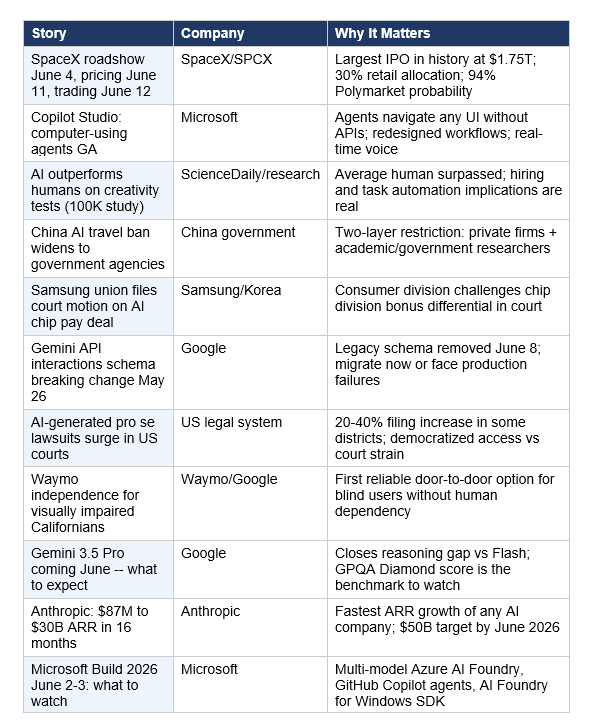
May 27 AI News at a Glance
Frequently Asked Questions
Has Anthropic confirmed the $900 billion funding round close?
Yes. Multiple sources confirmed that Anthropic's funding round closed during the week of May 26, 2026. The round exceeded $30 billion at a pre-money valuation above $900 billion, making Anthropic the world's most valuable private AI startup, surpassing OpenAI's $852 billion March 2026 valuation. The round was co-led by Sequoia Capital, Dragoneer Investment Group, Altimeter Capital, and Greenoaks Capital Partners, with Microsoft, NVIDIA, Founders Fund, and General Catalyst also participating. It is expected to be Anthropic's final private round before a public offering targeting October 2026.
When does the SpaceX IPO roadshow start?
The SpaceX IPO investor roadshow begins June 4, 2026. Pricing is scheduled for June 11 and trading opens on Nasdaq under the ticker SPCX on June 12, 2026. The offering targets a $1.75 trillion valuation and a raise of up to $75 billion, which would be the largest IPO in history. Goldman Sachs is the lead bookrunner. Thirty percent of the float is allocated directly to retail investors through Robinhood, Fidelity, and Charles Schwab. Polymarket prediction markets give a 94 percent probability of the offering completing within the June 2026 window.
What are Microsoft Copilot Studio computer-using agents?
Computer-using agents in Microsoft Copilot Studio, now generally available as of the May 2026 update published on May 26, are AI agents that interact with applications exactly as a human user would: navigating screens, clicking interface elements, filling forms, reading content from any visual display, and extracting data, all without requiring the application to have an API. This makes Copilot Studio agents usable with the long tail of enterprise software that was never designed for programmatic integration. The May 2026 update also ships redesigned workflows with conditional branching and parallel execution, Work IQ extensibility for workforce analytics signals, and real-time voice with sub-500ms latency for customer service deployments.
Can AI really beat humans at creativity?
A study of more than 100,000 people published this week found that today's generative AI systems outperform the average human on standardized creativity tests including the Alternative Uses Task and Remote Associates Test. The qualification researchers emphasize: these tests measure structured creative output and predict creative job performance, but they are not equivalent to the open-ended, culturally embedded creativity involved in producing art, literature, or music. The finding has real implications for hiring and task automation in roles requiring average creative output, but does not establish AI superiority on the full spectrum of human creativity.
What is the Gemini API breaking change from May 26?
On May 26, 2026, Google changed the default schema for the Gemini Interactions API. The request and response schema (outputs and steps fields) and output format configuration (response_format) are now updated to a new structure. The new schema became the default on May 26. The legacy schema will be removed entirely on June 8, 2026. Developers using the Interactions API in production have until June 8 to migrate or face API failures. Google published a migration guide. This is not a deprecation with months of runway -- it is an active breaking change with a two-week hard deadline.
What is the Samsung union court dispute about?
A Samsung Electronics union representing the company's consumer electronics division filed a motion in a South Korean court on May 26 to block a vote on a pay deal that disproportionately benefits chip division workers. Samsung's semiconductor division, which produces AI chips for NVIDIA and Google, has become significantly more profitable than consumer electronics, creating internal compensation pressure. The union argues the differential bonus and pay structure is unfair and seeks judicial review before the vote proceeds.
What should I watch for at Microsoft Build 2026?
Microsoft Build 2026 runs June 2 to 3 in San Francisco and online. Key things to watch: formalization of multi-model Azure AI Foundry support with Anthropic Claude officially available alongside OpenAI; GitHub Copilot multi-agent orchestration for parallel testing, documentation, and security scanning; the AI Foundry for Windows SDK bundling ONNX Runtime and DirectML; enterprise governance for computer-using agents; and Agent 365 audit capabilities. The strategic test is whether Satya Nadella can position Copilot as a model-agnostic platform rather than an OpenAI distribution channel.
Recommended Reads
- AI News Today -- May 24, 2026: $900B Funding, Papal Encyclical, and an Overdue Model -- Build Fast with AI
- AI News Today -- May 22, 2026: Anthropic Goes Profitable, OpenAI Files for IPO -- Build Fast with AI
- Google I/O 2026: Gemini 3.5 Flash and All Developer Announcements -- Build Fast with AI
- Claude Mythos: Release Date, Access, and What Comes Next (2026) -- Build Fast with AI
- Best AI Models April 2026: Ranked by Benchmarks -- Build Fast with AI
- What Is Claude Cowork? The 2026 Guide -- Build Fast with AI
- AI Models in March 2026: The Week That Changed AI -- Build Fast with AI
References
- Yahoo Finance -- Anthropic set to close $30 billion funding at over $900 billion valuation
- Bloomberg -- Anthropic to Close Over $30 Billion Round as Soon as Next Week
- Bitrue -- SpaceX IPO Facts: 2026 Guide, Date, and Price Predictions
- Microsoft Copilot Blog -- What's new in Copilot Studio: May 2026 updates
- ScienceDaily -- Generative AI beats average human on certain creativity tests (study of 100,000+)
- Bloomberg -- China Limits Overseas Travel for AI Talent at DeepSeek, Alibaba, Private Firms
- Reuters -- Samsung union asks South Korean court to block AI chip pay deal vote
- Google AI Developers -- Gemini API Release Notes (Interactions schema breaking change May 26)
- New York Times -- AI-generated pro se lawsuits surge, consuming more court resources
- New York Times -- Visually impaired Waymo users say rides give them independence
- WaveSpeed -- Gemini 3.5 Pro Is Coming Next Month: What Flash Already Tells Us

