



Nobody in Indian AI publishes a price. Ask what it costs to build an AI agent and you get a discovery call, a proposal three weeks later, and a number that could be 3 lakh or 30 lakh with no way to tell why. That opacity is a choice, and it is not in your favour. So here is ours, with the reasoning behind it, because a company deciding whether to deploy AI deserves a real range before it spends a rupee.
The honest headline is that the model is the cheapest part of an AI project, and almost every quote hides that. What you actually pay for is the 80 percent around the model: your messy data, your systems, the integrations, the failure handling, and the person who keeps it running. This guide gives you real cost ranges for India in 2026, the hidden costs to expect, and a clear way to compare building, buying, and deploying, so you can budget with your eyes open.
What AI Deployment Actually Costs in India
AI deployment in India in 2026 typically costs between about 3 lakh and 25 lakh or more, depending entirely on how many systems it touches and how messy your data is. A single, well-defined workflow on reasonably clean data sits at the low end. A multi-workflow system that integrates with several of your existing tools and handles real-world data chaos sits much higher. The number is driven by scope and integration, not by the AI model, which is often the smallest line on the invoice.
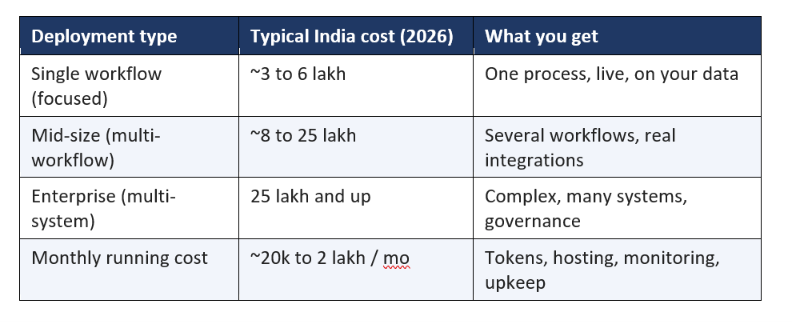
Treat these as market ranges, not a quote, because your real number depends on your specific systems and data. The point is to give you a defensible starting frame so you can tell whether a proposal is reasonable. If someone quotes you 30 lakh for a single clean-data workflow, or 1 lakh for an enterprise multi-system build, you now know enough to ask why.
Why Nobody Publishes a Price (and Why We Will)
Indian AI vendors do not publish prices because opacity protects their margin and their flexibility, not your budget. When every quote starts from a blank discovery call, the vendor can price to the client's perceived budget rather than the work, and the buyer has no benchmark to push back with. Publishing a number is a positioning move as much as a pricing one: it says we know what this costs because we have shipped it, and we are not afraid to tell you.
There is a real reason prices vary, to be fair. AI deployments genuinely differ in scope, and a fixed price on undefined work is a trap for both sides. But that is an argument for transparent ranges and fixed-scope pricing, not for hiding numbers entirely. A serious buyer wants to know the shape of the cost before the sales process, and a serious vendor should be able to give it.
So this is our position: real ranges up front, fixed scope and fixed price once the work is defined, and a clear explanation of what sits inside the number and what is deliberately outside it. What you exclude builds more trust than what you include, and it ends the scope-creep conversations before they start. For related business-side benchmarks, our corporate AI training cost guide for India applies the same transparency to upskilling.
Cost by Project Size: The Real Ranges
The clearest way to budget AI in India is by project size, because scope drives everything. A focused single-workflow deployment, say automating one document-heavy process, is the entry point and the smartest place for most companies to start. It is countable, it has a clear baseline, and it proves value fast. A mid-size deployment spanning several workflows and integrations costs multiples more, because each new system it touches adds integration, testing, and failure-handling work.
Enterprise deployments are a different category. Once a system spans many tools, needs governance and audit, and serves large user groups, the cost reflects the coordination, the compliance, and the reliability engineering, not just the AI. This is where the 80 percent balloons, and where a naive per-model estimate is most dangerous. A useful rule: the cost roughly tracks the number of systems the AI must reliably read from and write to, not the sophistication of the model.
My advice for most Indian mid-market companies is to start with the highest-return single workflow, usually a back-office process rather than a customer-facing one, because it has a countable baseline and the least risk. Prove the return there, then expand. That sequencing keeps the first number small and the ROI legible, which is exactly what makes the second project easy to fund.
It is also worth being honest about what raises a quote beyond these ranges. Strict compliance and audit requirements, real-time latency demands, very high volume, and data that is spread across many old systems all push a project up a tier. A company in a regulated sector, or one whose data lives in a dozen disconnected tools, should expect the higher end of each band, not the lower. None of that is a reason to avoid AI, but it is a reason to scope carefully and to distrust any quote that treats your regulated, multi-system reality as if it were a clean demo.
The Hidden 80%: Costs Nobody Quotes
The reason AI budgets blow up is the hidden 80 percent: the costs that never appear in the model line but decide the real price. The model API might be a few thousand rupees a month. The work around it, integrating your systems, cleaning and handling your data, building permissions, handling failures, and maintaining it, is where the money goes. A quote that only prices the model is not cheaper, it is incomplete, and the gap shows up as overruns later.
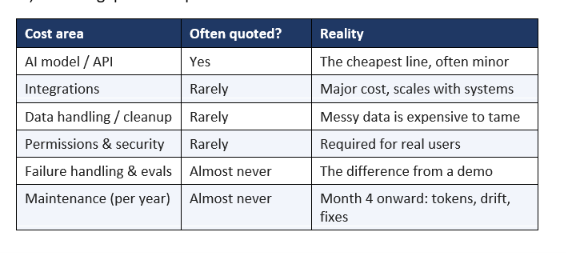
Month four is when AI projects get expensive, and almost nobody warns you. Token costs at real volume, latency tuning, the model version that changed under you, and the fixes as your data evolves all land after launch. A serious cost estimate includes a maintenance line, usually a monthly figure, because a system that nobody budgets to maintain is a system that quietly breaks. For the enterprise decision-making around this, an AI readiness assessment helps you size the real scope before you commit.
Build vs Buy vs Deploy: 12-Month Cost
Over twelve months, building in-house, buying a generic tool, and deploying with a specialist team produce very different total costs, and the cheapest sticker price is rarely the cheapest outcome. Building in-house means hiring scarce talent and carrying a long ramp before anything ships. Buying a tool is cheap up front but often bends your specific workflow to a generic product that does not fit. Deploying with a specialist team costs more than a tool and less than a full in-house build, and it ships a system that fits your actual process.
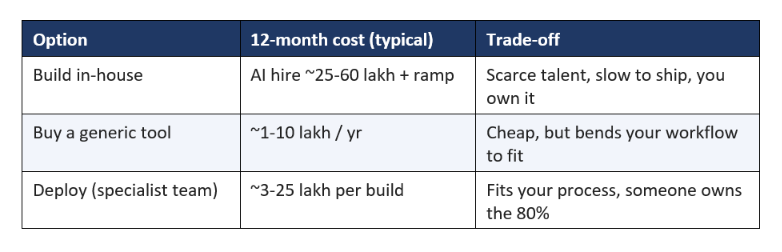
The in-house numbers reflect the reality that a capable AI engineer in India is expensive and hard to hire, as our AI jobs in India salary guide and forward deployed engineer salary breakdown show. For a company with twenty engineers and no AI engineer, spending 40 lakh a year to build a capability from scratch, before shipping anything, is usually the wrong first move. A focused deployment gets you a live system for a fraction of that, and you can bring it in-house later once the value is proven.
Cost by Workflow Type: Where AI Pays Back Fastest
AI deployment cost also varies by the type of workflow you automate, because some are simpler to integrate and easier to measure than others. Document-heavy back-office processes tend to be the cheapest to deploy and the fastest to pay back, since the baseline is countable and the data lives in one place. Customer-facing and multi-system workflows cost more, because they touch more tools and carry more risk.
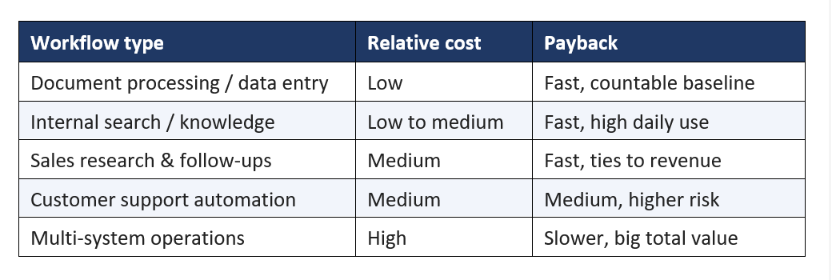
The pattern is clear: start where the cost is low and the baseline is countable. A document-processing or internal-knowledge workflow gives you a fast, defensible win at the low end of the price range, which funds confidence for the bigger, higher-value projects later. Our playbook on AI for sales teams covers the fastest revenue-linked workflow if you want to lead with pipeline impact instead.
What Drives the Price Up or Down
The price of an AI deployment in India is driven up or down by a handful of concrete factors, and knowing them lets you control the number. Understand these and you can scope a project to your budget instead of being surprised by it.
- Number of systems it integrates with. Each system adds real integration and testing cost. Fewer systems, lower price.
- Data quality. Clean, digital, English data is cheap. Hinglish, scans, and inconsistent formats add cost.
- Whether the systems have APIs. A clean API is cheap. A 15-year-old app with no API is expensive to work around.
- Approval and governance needs. Human-in-the-loop, audit, and compliance add reliability engineering.
- Volume and latency. Higher throughput and stricter speed requirements raise both build and running costs.
The lever most companies miss is scope. You do not have to automate everything at once, and you should not. Narrow the first project to one high-return workflow on your least-messy data, and the price drops sharply while the ROI stays high. Expand from a working, owned system, not from a stalled everything-at-once pilot. That single decision is worth more to your budget than any vendor negotiation.
A Real Cost Example: One Document Workflow
Here is an illustrative costing so the ranges feel concrete. A 300-person company wants to automate invoice processing, a single, document-heavy back-office workflow. The AI model cost is trivial, a few thousand rupees a month at their volume. The real build is the 80 percent: OCR and Hinglish handling for the scanned invoices, a browser-automation bridge into an accounting tool with no API, permissions, an approval step above a value threshold, an eval set, and monitoring.
Scoped honestly, that single-workflow build lands around 4 to 6 lakh, with an ongoing running and maintenance cost near 25,000 to 40,000 a month. Against that, the process currently consumes a few hundred person-hours a month of finance-ops time at a loaded cost, so the payback lands inside a quarter. The number is defensible because it is priced against a countable baseline, not pulled from the air, and because the 80 percent is in the quote rather than hidden.
Now compare the naive version. A vendor who quotes only the model and a thin wrapper might say 1.5 lakh, win the deal, and then discover the no-API accounting tool and the unreadable scans in month two, at which point the real cost surfaces as overruns and delay. The honest 5 lakh quote that includes the 80 percent is cheaper than the 1.5 lakh quote that does not, because the work does not disappear just because nobody costed it.
The Cost of Doing Nothing
The most overlooked number in any AI budget is the cost of doing nothing, and it is rarely zero. Every week a team runs a slow, manual process that AI could handle is capacity you are already paying for and throwing away. A no-deployment scenario is not a free baseline, it is a steady leak, and the honest comparison is the deployment cost against that ongoing waste, not against an imaginary zero.
Put a number on it the same way you would justify any deployment. If a back-office process consumes, say, a few hundred person-hours a month at a loaded cost, that is the recurring drain a deployment offsets. Against that, a 3 to 6 lakh single-workflow build often pays back inside a quarter, which is exactly why starting with a countable back-office workflow makes the economics so easy to defend.
This is also the argument that gets a project funded this quarter instead of next year. Framed as a cost, AI deployment competes with every other line item. Framed as stopping an existing, measurable leak, it becomes obvious. The teams that ship are the ones that quantify the waste they are already absorbing and show the deployment as the cheaper of two numbers.
There is a competitive edge in doing this sooner rather than later, too. The next real shift in AI is not another model release, it is the first company in your sector that puts a working system in its profit and loss statement while the rest are still running dead pilots. Cost framed only as an expense delays that move. Cost framed against the leak, and against a competitor who is about to move first, is what turns a stalled AI conversation into a funded, shipped system.
5 Questions to Ask Before You Pay for AI
Before you sign any AI deployment contract in India, five questions will tell you whether the quote is real and whether the vendor has actually shipped before. Ask these, and a serious partner will have crisp answers while a demo-only shop will get vague.
1What is inside the price, and what is deliberately outside it? A clear boundary signals a team that has shipped and knows where scope creep hides.
How will the AI read from and write to my existing systems? If they cannot answer this per system, they have not looked at the 80 percent.
What happens when a dependency is down or the input is bad? A real answer means they design for failure, not just the happy path.
Who owns and maintains it after launch, and what does that cost? No maintenance line means no plan for month four.
How will we measure that it works? If the answer is not evals on real cases, you are buying a demo.
The answers to these five questions tell you more than any price. A vendor who prices only the model and cannot answer the integration, failure, ownership, and eval questions is selling you a demo with a production-sized invoice waiting behind it. A partner who answers all five crisply, and prices the 80 percent openly, is worth more even at a higher sticker number, because their number is the real one.
Fixed Scope, Fixed Price: How DEPLOY Prices It
The fix for opaque AI pricing is fixed scope and fixed price: define exactly what the system does, what is inside the build, and what is deliberately outside it, then quote a firm number. This is how the DEPLOY program prices an AI build, because a defined scope is the only fair basis for a fixed price, and it protects both sides from the scope creep that wrecks so many projects. You know the number, you know the boundary, and you know who owns the 80 percent.
What sits inside a DEPLOY build is the whole production system, the integrations, the data handling, the failure cases, the approval boundary, and the ownership, not just a model on your data. What sits outside is stated plainly up front, because clear exclusions build more trust than a long list of vague inclusions, and they end the scope conversation before it starts. That transparency is the point, and it is the opposite of the discovery-call-and-guess model that dominates Indian AI.
So the real answer to what AI deployment costs in India is this: it costs the 80 percent, priced honestly, against the leak it stops. Start with one high-return workflow, get a fixed-scope number, and judge it against the cost of doing nothing. Do that, and you will neither overpay for a demo nor under-scope a system that was always going to need the hard 80 percent. For the models that power these builds, our best AI models of 2026 ranking keeps your options current.
If you take one number away from this guide, make it this: the model is the cheapest line on the invoice, and the 80 percent is the whole game. Price that honestly, start small, own it, and AI deployment in India stops being a mystery quote and becomes a decision you can actually make.
Frequently asked Questions
How much does it cost to build an AI agent in India?
Building an AI agent in India in 2026 typically costs about 3 to 6 lakh for a single focused workflow, 8 to 25 lakh for a mid-size multi-workflow system, and 25 lakh or more for complex enterprise builds. The model is the cheap part. Most of the cost is integration, data handling, and maintenance, so always get a scoped quote for your specific workflow.
What does AI deployment cost for a company in India?
It depends on how many systems the AI touches and how messy the data is, ranging from a few lakh for one clean workflow to tens of lakh for multi-system enterprise deployments, plus a monthly running cost of roughly 20,000 to 2 lakh for tokens, hosting, and upkeep. Scope, not model choice, drives the number.
Which AI workflow is cheapest to deploy first?
Document processing, data entry, and internal knowledge search are usually the cheapest AI workflows to deploy and the fastest to pay back, because the data is contained and the time saved is easy to count. They sit at the low end of the cost range, typically a 3 to 6 lakh build, which makes them the smartest first project for most Indian companies.
Why do Indian AI vendors not publish prices?
Most Indian AI vendors hide prices because opacity lets them quote to a client's perceived budget rather than to the work, and because genuine scope differences make a blanket price risky. The better answer is transparent ranges up front plus fixed scope and fixed price once the work is defined, which is how a serious deployment should be quoted.
Is it cheaper to build AI in-house or hire a team?
For most companies without an existing AI engineer, deploying with a specialist team is cheaper over the first year than building in-house, because a capable AI hire in India costs tens of lakh per year plus a long ramp before anything ships. A focused deployment delivers a live system for a fraction of that, and you can internalise it later once value is proven.
What are the hidden costs of AI projects?
The hidden costs are integrations, data cleanup, permissions and security, failure handling and evaluations, and ongoing maintenance. The AI model API is usually the smallest line. Month four onward brings token costs at real volume, latency tuning, model changes, and fixes, so a serious estimate always includes a maintenance figure.
How much does AI maintenance cost per year?
Ongoing AI running and maintenance costs commonly land around 20,000 to 2 lakh per month in India, depending on volume, hosting, and how much the system evolves. This covers tokens, monitoring, and fixes. Budgeting zero for maintenance is the most common costing mistake, because an unmaintained system quietly degrades.
What is the cheapest way to start with AI in India?
The cheapest sensible start is a single, high-return back-office workflow on your least-messy data, typically a 3 to 6 lakh build with a countable baseline. It proves value fast and at low risk, which makes the next, larger project easy to justify. Avoid trying to automate everything at once, since scope is the biggest cost driver.
How do I know if an AI quote is fair?
A fair AI quote itemises the 80 percent, not just the model: integrations, data handling, permissions, failure handling, evals, and a monthly maintenance figure. If a quote only prices the model and a thin wrapper, it is incomplete and will surface as overruns later. A number that names its inclusions and exclusions is more trustworthy than a lower one that hides the real work.
Should AI running cost be monthly or one-time?
AI deployment has both: a one-time build cost and an ongoing monthly running cost for tokens, hosting, monitoring, and fixes, commonly 20,000 to 2 lakh a month in India depending on volume. Budgeting only the one-time build and ignoring the monthly line is the most common costing mistake, because an unmaintained system degrades from month four onward.
Recommended Blogs
- Forward Deployed Engineer Salary India 2026 (Bands)
- Corporate AI Training Cost in India: 2026 Pricing
- AI Jobs in India Salary (2026): Complete Pay Guide
- AI Upskilling: How to Train 1,000 Employees
- Best AI Models 2026: Full Ranked Analysis and Benchmarks

