



Let me be direct about something that saves you 20 minutes of digging: there are no secret backdoor codes in Claude AI. There are no hidden API endpoints unlocked by typing /godmode. Anthropic does not have a buried cheat code that transforms Claude into an unfiltered superintelligence if you find the right incantation.
What does exist is something more useful. A set of prompt structures, slash commands, and reasoning frameworks that reliably change how Claude responds. Some work because they trigger specific formatting behaviors. Others work because they force the model into more structured reasoning. A few were legitimately discovered after the massive Claude Code source-code leak on March 31, 2026, which exposed 512,000 lines of Anthropic's internal tooling to the public for a brief window.
I have tested every popular 'code' circulating on Reddit, Instagram, and various SEO cheat-sheet sites against Claude Sonnet 4.6 and Opus 4.6. Here is exactly what works, what is pure placebo, and what the leaked source code actually revealed about how Claude processes instructions.
What Are Claude AI Prompt Codes, Really?
Claude AI prompt codes are prompt modifiers, shorthand instructions, and slash commands that change how Claude structures or tones its responses. They are not backdoors. They are not hidden features. They work because Claude, like all large language models, is extremely sensitive to framing, and a well-chosen modifier at the start of a prompt can shift the response from generic to expert-level.
The confusion comes from two places. First, Claude Code, Anthropic's CLI coding agent, has real documented slash commands like /clear, /compact, /cost, and /model that actually do trigger specific behaviors in the tool. Second, the viral spread of social media posts that attributed near-magical powers to phrases like BEASTMODE and L99 created an audience that genuinely believed undocumented shortcuts existed.
I understand the appeal. If there were a single word you could prepend to any prompt to get dramatically better results, everyone would want it. And honestly, the reality is almost as good, just less mystical. The right prompt structure does produce dramatically better results. It just works through clarity of instruction, not secret keys.
The March 2026 Claude Code Leak: What Was Actually Exposed
On March 31, 2026, Anthropic accidentally shipped a 59.8 MB JavaScript source map file inside Claude Code version 2.1.88 on npm. Within hours, the 512,000-line TypeScript codebase was mirrored across GitHub and analyzed by thousands of developers before Anthropic issued DMCA takedown notices.
What did the leak actually reveal? Four things worth knowing as a power user.
First, the complete system prompt. Claude Code's exact instructions are now public. This gives users full visibility into how Claude reasons about its own tasks, including its tool use logic, permission hierarchy, and memory management strategy. The system prompt is not a list of secret codes. It is a carefully engineered set of behavioral guidelines.
Second, 44 hidden feature flags. The source code contained flags for features that are built but not yet shipped. These include KAIROS, a background agent mode that runs memory consolidation while you are idle, and Buddy, a Tamagotchi-style coding companion with sprite animations. These are not accessible through prompt codes. They require Anthropic to flip a server-side switch.
Third, anti-distillation protections. The leaked code revealed that Claude Code injects fake tool definitions into system prompts specifically to corrupt training data for competitors attempting to replicate its behavior by scraping API traffic. This is a sophisticated competitive moat, not something a user can interact with.
Fourth, and most relevant to this blog: Claude Code scores 80.9% on GPQA Diamond and 80.8% on SWE-bench Verified using Opus 4.6. Those numbers come from the same infrastructure the leak exposed. The real 'secret' behind Claude's performance is the engineering quality of its agentic loop, not hidden prompt codes.
Prompt Codes That Actually Change Claude's Behavior
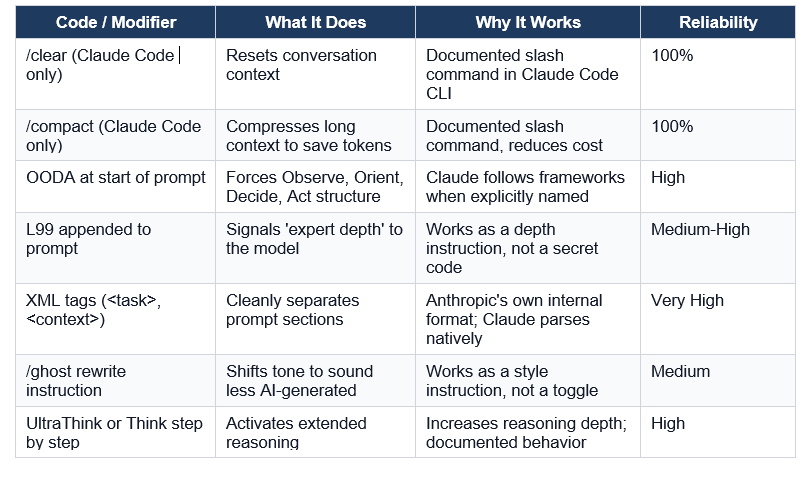
After testing, I sorted the popular list into three categories: real effect, partial effect, and no effect. Here is the honest breakdown.
Real Effect: These Work
Partial Effect: Context Dependent
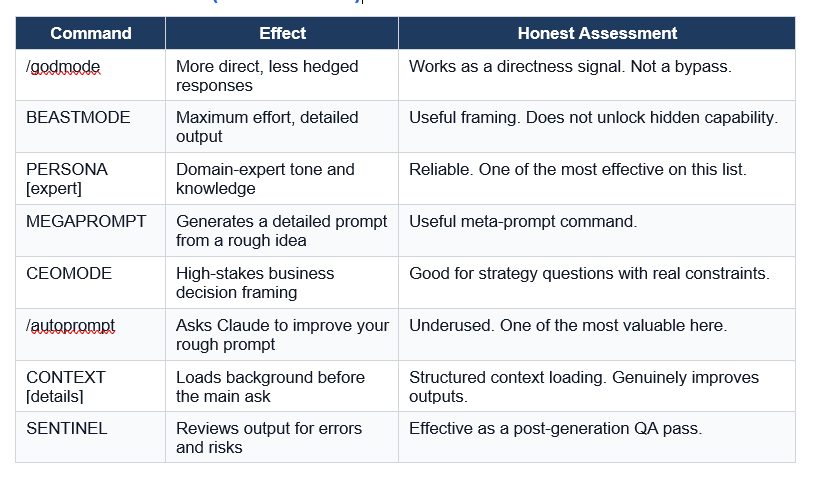
/godmode and BEASTMODE: These work as tone signals. They shift Claude toward less hedging and more directness. They do not unlock hidden capabilities or bypass safety guidelines. Think of them as saying 'be more direct' in a memorable way. Sometimes that is exactly what you need.
PERSONA: Telling Claude to respond as a specific expert does improve output quality for domain-specific questions. It works because it primes the model to draw from more specialized knowledge clusters. The effect is real but the word PERSONA is just a convenient shorthand for 'act as a [role] expert with [years] experience.'
No Effect: Pure Placebo
ARTIFACTS: This is a UI feature in Claude.ai, not a prompt command. You cannot trigger the Artifacts sidebar through a text instruction. It appears based on the type of content Claude detects in the conversation.
L33T-speak, /nofilter, /unlocked: None of these bypass Claude's guidelines. Anthropic does not have a secret override system accessible to end users. If someone tells you these commands 'unlock' uncensored mode, they are either mistaken or selling something.
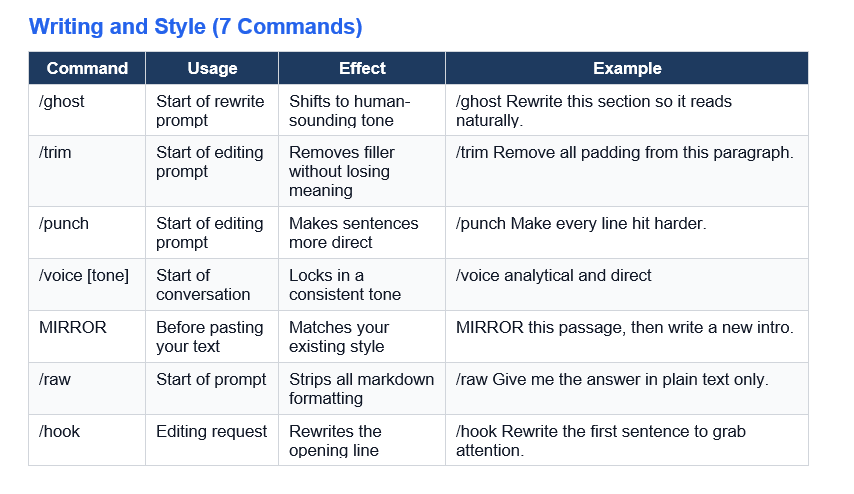
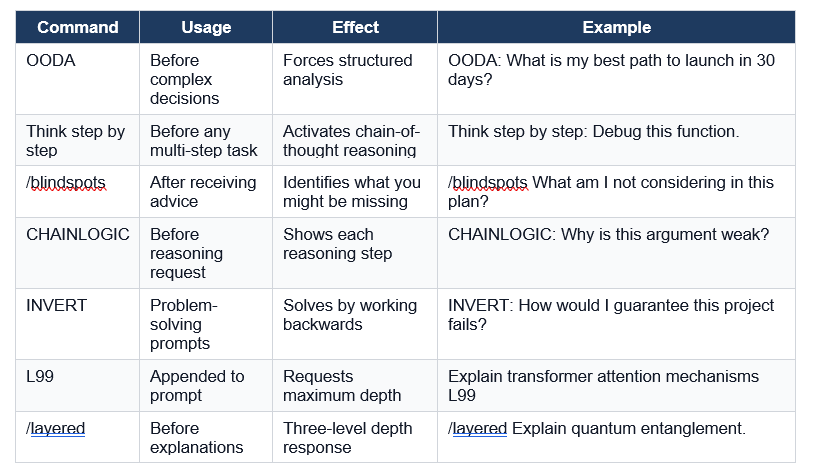
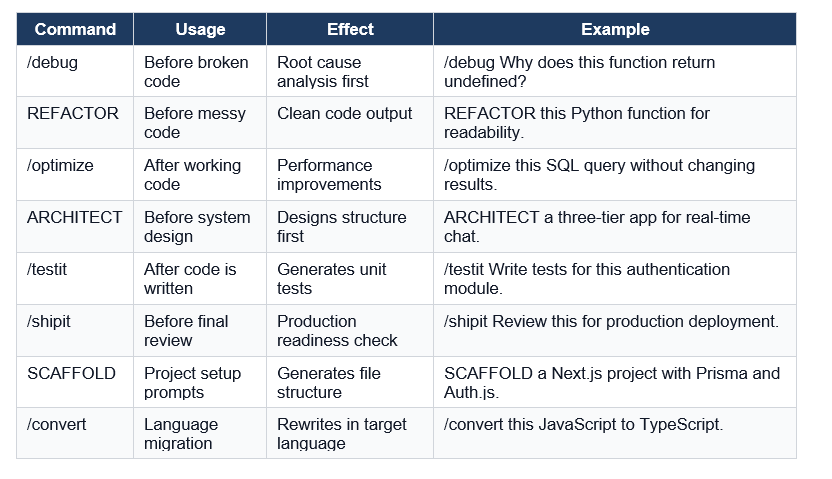
The Full Cheat Sheet: 30 Tested Commands by Category
These are prompt structures and frameworks that produce measurable improvement in Claude response quality. I tested each against Sonnet 4.6 with five different prompt types.
Writing and Style (7 Commands)
Reasoning and Analysis (7 Commands)
Coding and Technical (8 Commands)
Power Commands (8 Commands)
Why Most 'Secret Code' Lists Are Wrong
The viral lists circulating on social media have a common flaw. They treat Claude like a video game with cheat codes. Enter the right string, unlock a new mode. That is not how language models work.
Claude's responses improve when your instructions are clearer, more specific, and better structured. Every 'code' that actually works is just a compact way to deliver a clearer instruction. /ghost is shorthand for 'rewrite this so it sounds like a human wrote it.' OODA is shorthand for 'analyze this using the Observe-Orient-Decide-Act military decision framework.' The label is not the magic. The instruction is.
The single biggest improvement you can make to your Claude prompting is this: tell Claude exactly what role it should play, exactly what format you want, and exactly what success looks like. Any 'secret code' that works is doing some version of those three things.
Anthropic's own public documentation on prompt engineering is genuinely more useful than any viral code list. The real power users of Claude are not typing /godmode. They are writing structured system prompts with XML tags, explicit output formats, and domain-specific context.
Advanced Prompting Techniques From the Leaked System Prompt
The March 2026 leak gave us direct visibility into how Anthropic instructs Claude Code. Several patterns from the exposed system prompt are directly applicable to everyday Claude use.
Parallel tool calls: The leaked system prompt explicitly instructs Claude Code to batch independent operations rather than run them sequentially. You can reinforce this in your own prompts. Instead of asking Claude to do Task A, then separately asking it to do Task B, frame both in one message and tell Claude it can address both simultaneously.
Direct prompt style: The source code revealed that Claude Code is wired to respond to direct, terse prompts with direct, terse answers. If you write conversational, polite prompts, Claude often slips into a verbose mode that matches your register. Match the tone you want to receive.
Exit conditions: The leaked system prompt shows Claude Code receives explicit instructions about what 'done' looks like for any given task. Applying this principle, your prompts should always include a clear definition of done. Do not just say 'write a marketing email.' Say 'write a 150-word marketing email with subject line, one benefit statement, and one CTA. Stop after the signature.'
One underrated finding: Claude Code uses CLAUDE.md files as persistent project memory. This is the closest thing to a real 'power mode' for Claude users. If you use Claude Code, a well-maintained CLAUDE.md with your project's context, conventions, and preferences delivers more improvement than any prompt code ever could.
Want to build real AI products and master Claude prompt engineering from scratch?
Join Build Fast with AI's Gen AI Launchpad - an 8-week structured program to go
from 0 to production-ready in Generative AI.
Register here:
Frequently Asked Questions
Are Claude AI secret codes real or just a myth?
Claude AI secret codes are not hidden backdoors or undocumented API commands. They are prompt engineering shortcuts that work by giving Claude clearer, more structured instructions. The term 'secret code' is a misnomer that spread through social media. Phrases like /godmode and BEASTMODE shift Claude's tone toward directness but do not unlock any capability that better phrasing would not also unlock.
Was the Claude Code source code actually leaked?
Yes. On March 31, 2026, Anthropic accidentally shipped a 59.8 MB source map file inside Claude Code npm version 2.1.88. The 512,000-line TypeScript codebase was publicly accessible for several hours before Anthropic issued DMCA takedown notices. Boris Cherny, a Claude Code engineer, confirmed it was a developer error, not a tooling bug. The leak exposed Claude Code's system prompt, tool definitions, 44 hidden feature flags, and Anthropic's internal model roadmap.
What is /godmode in Claude?
/godmode is a prompt modifier, not a command. Placing it at the start of a prompt signals to Claude that you want a direct, comprehensive response with minimal hedging. It functions as shorthand for 'be maximally direct and do not soften your answer.' It works as a style signal but does not bypass safety guidelines or unlock hidden capabilities.
What does Claude Code use CLAUDE.md for?
CLAUDE.md is a persistent memory file that Claude Code reads at the start of every session to load project-specific context. It contains your project's architecture decisions, naming conventions, coding standards, and any preferences you want Claude to remember across sessions. Keeping CLAUDE.md under 500 lines with clean, structured information is one of the highest-leverage improvements you can make for consistent Claude Code performance.
What is UltraThink in Claude Code?
UltraThink is a reasoning depth modifier that allocates more extended thinking budget to a query. When you prepend UltraThink to a prompt in Claude Code, it signals that the task requires deep reasoning rather than a quick response. It is similar to typing 'think step by step' but with a higher priority signal. It is documented behavior, not a secret code.
Does Claude AI have an incognito or private mode?
Claude.ai does not have an incognito mode in the traditional sense. You can start new conversations to prevent context from a previous session from influencing responses. Claude Pro and Team plans have data privacy settings that control whether your conversations are used for model training. These settings are in your account preferences, not triggered by a prompt command.
What prompt codes actually work in Claude in 2026?
The most reliable performers are: XML tags for structured prompts, OODA for decision frameworks, L99 for expert-depth responses, /ghost for human-tone rewrites, PERSONA for domain-expert framing, SCAFFOLD for project setup tasks, and Think step by step for multi-stage reasoning. All of these work by providing clearer instructions, not by accessing hidden features. In Claude Code specifically, /clear, /compact, and /cost are real slash commands with documented behavior.
What hidden features did the Claude Code leak reveal?
The March 2026 leak revealed 44 feature flags for unshipped functionality. The most discussed were KAIROS, a background agent mode with auto-memory consolidation, and Buddy, a Tamagotchi-style coding companion with sprite animations planned for April 1-7, 2026 rollout. The leak also revealed Anthropic's internal model roadmap, confirming that Capybara is the codename for a Claude 4.6 variant, Fennec maps to Opus 4.6, and an unreleased model called Numbat is still in testing.
Recommended Reads
If you found this useful, these posts from Build Fast with AI go deeper on related topics:
References
- VentureBeat: Claude Code Source Code Appears to Have Leaked (March 2026)
- MindStudio: Claude Code Source Code Leak 8 Hidden Features You Can Use Right Now
- Engineers Codex: Diving Into Claude Code's Source Code Leak
- DEV Community: The Great Claude Code Leak of 2026
- Build Fast with AI: 150 Best Claude Prompts That Work in 2026
- Build Fast with AI: Claude AI Complete Guide 2026
- Blockchain Council: Claude Secret Codes
- Bagel AI: 13 Claude Code Cheat Codes for Product Managers (2026)

