


What Is Perplexity Computer? The 19-Model AI Agent That Changes Everything (2026)
Three AI company CEOs walked into San Francisco in the same week. Sam Altman claimed 800 million weekly ChatGPT users. Sundar Pichai pushed Gemini into every Google product. And Aravind Srinivas, the 31-year-old IIT Madras graduate who built Perplexity AI, quietly dropped something different entirely. On February 25, 2026, Perplexity launched Computer, a multi-model AI agent that orchestrates 19 different AI models to complete complex, long-running tasks on your behalf. No single chatbot. No one-model bottleneck. Just one system that picks the right AI for each job and runs until it is done.
I have been watching AI tools long enough to know hype from substance. And this one, I think, is substance. Not because of the marketing. Because of the architecture.
. What Is Perplexity Computer?
Perplexity Computer is an autonomous AI agent launched on February 25, 2026, that coordinates 19 different AI models to complete complex, multi-step workflows entirely in the background. You describe a goal, and Computer breaks it into subtasks, assigns each to the best-suited AI model, runs them simultaneously using specialized sub-agents, and delivers finished results.
Think of it this way: before Computer, using AI meant switching between tools. You would use Claude for coding, Gemini for image analysis, GPT-5.2 for long documents. Manual juggling. Computer eliminates that by doing the juggling for you, automatically.
The product is currently available exclusively to Perplexity Max subscribers at $200 per month. It runs entirely in the cloud, meaning you do not need a powerful local machine. Tasks execute in an isolated environment with a real filesystem, browser access, and connections to over 400 applications including Slack, Gmail, GitHub, and Notion.
Here is why this matters: in January 2025, over 90% of enterprise AI tasks ran through just two models. By December 2025, no single model handled more than 25% of usage across businesses. Models stopped converging into general-purpose tools. They started specializing. Computer is built around that reality.
2. How Does Perplexity Computer Work?
The architecture is where this gets genuinely interesting. Computer is not one AI doing everything. It is an orchestration layer that routes each part of your task to the model that handles that type of work best.
The 5-step workflow inside every Computer task:
- Step 1: Goal Input - You describe what you want. 'Build me an interactive stock dashboard for my top 10 holdings' or 'Plan and execute a content calendar for my SaaS product launch.'
- Step 2: Task Decomposition - Computer breaks that goal into specific subtasks: research, data collection, writing, design, code generation, etc.
- Step 3: Model Selection - The system routes each subtask to the right model. Claude Opus 4.6 for reasoning and software engineering. Gemini for deep research and visual outputs. GPT-5.2 for long-context recall. Grok for fast, lightweight tasks. Nano Banana for image generation. Veo 3.1 for video.
- Step 4: Parallel Execution - Sub-agents run simultaneously. The entire workflow does not wait for one model to finish before the next starts.
- Step 5: Continuous Optimization - The system monitors output quality, self-corrects, and delivers final results.
The result is a system that can handle workflows that would take a human team hours, days, or even months. Early users demonstrated Computer building Bloomberg Terminal-style financial dashboards, replacing entire six-figure marketing tool stacks over a single weekend, and automating data pipelines that previously required dedicated engineers.
My honest take: the 19-model orchestration is genuinely clever engineering. But the credit system, which charges per task complexity without publishing a clear table of costs, is a problem I will address in the pricing section.
3. Perplexity Computer vs ChatGPT: Key Differences
The most common question I see: is Perplexity the same as ChatGPT? Short answer: no. Longer answer: they are solving different problems.
ChatGPT is a conversational AI. It excels at writing, explaining concepts, generating code snippets, and having back-and-forth dialogue. You ask, it answers. It is fundamentally reactive.
Perplexity Computer is proactive and agentic. You set a goal, walk away, and come back to a finished deliverable. It is less 'chat assistant' and more 'autonomous digital employee.' That is a meaningful distinction.
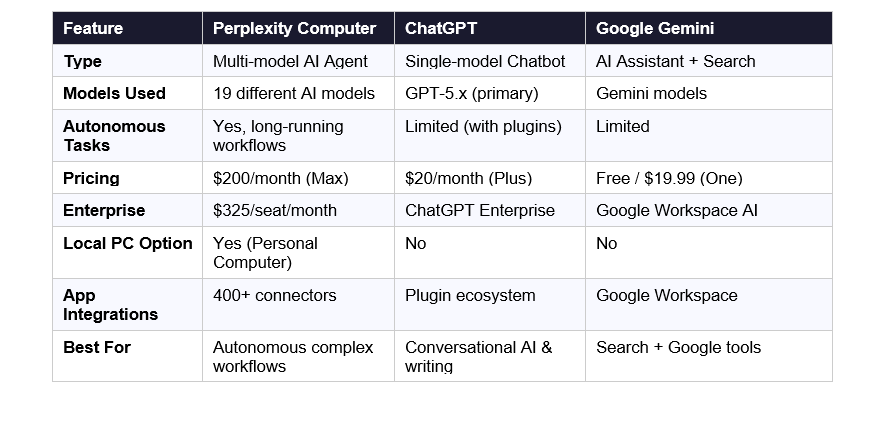
The comparison that actually matters is not ChatGPT vs Perplexity Computer. It is single-model tools vs multi-model orchestration. OpenAI's tools optimize within one model. Perplexity's bet is that the future belongs to whoever orchestrates all models together.
I think Perplexity is right about the direction. Whether $200/month is the right price for where the technology is right now, that is a separate conversation.
4. Perplexity Computer Pricing Breakdown
Pricing is where things get complicated. Here is the full picture as of March 2026:
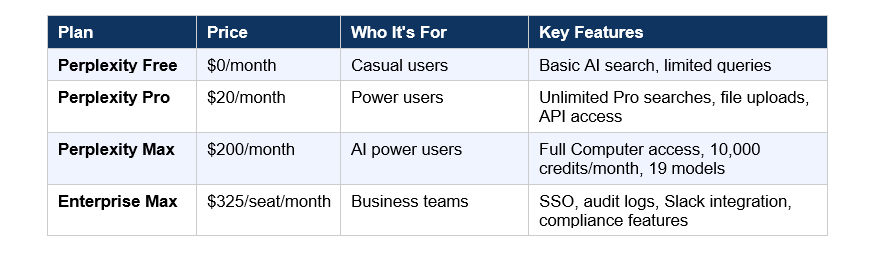
The Max tier gives subscribers 10,000 credits per month. Each task consumes credits based on complexity. Simple research tasks use fewer credits. Long multi-day workflows burn through them faster. The problem: Perplexity has not published a clear table showing exactly how many credits each task type costs. That makes budgeting frustrating for heavy users.
The Enterprise tier at $325 per seat per month ($3,250/year) adds organization-level security controls, SCIM provisioning, configurable data retention, audit logs, and Slack integration where employees can query @computer directly inside team channels.
My take on the pricing: $200/month is steep for individual users. For a small business that currently pays for separate research tools, marketing software, and data analysis subscriptions, the math could work out. For individuals just experimenting with AI, start with the free tier or Pro at $20/month first.
Don't just use ChatGPT. Learn to build custom LLM agents, RAG pipelines, and full-stack Agentic AI apps in our intensive 6-week program.
5. Perplexity Personal Computer: The Local Desktop Agent
Perplexity Personal Computer is a separate product launched on March 11, 2026, at the inaugural Ask 2026 developer conference. It runs on a dedicated local device, such as a Mac Mini, giving the cloud-based AI agent persistent access to your local files, applications, and sessions.
Here is the difference between the two products:
- Perplexity Computer (cloud-based): Runs entirely in Perplexity's cloud infrastructure. Fast, scalable, no local hardware required. Best for research, content creation, data workflows.
- Perplexity Personal Computer (local): Runs on your physical device with access to local files. The AI can open apps, manage files, and operate sessions that persist even when you are offline.
The local product addresses a privacy concern that many users raised about the cloud version: sensitive documents, proprietary code, and personal files never need to leave your machine.
Perplexity says Personal Computer includes user approval requirements for all sensitive actions, a full audit trail for every session, and a kill switch for emergency stop. Given that similar open-source tools like OpenClaw have caused serious damage to users' systems when running autonomously, those safeguards are not optional extras. They are table stakes.
6. Is Perplexity Computer Available on PC?
Yes, Perplexity Computer is available on PC and all major platforms. The cloud-based version of Computer runs in your browser, accessible from any Windows PC, Mac, Linux machine, or mobile device. You do not need to install anything.
For Windows users specifically, access works through:
- Perplexity's web interface at perplexity.ai (any browser, including Chrome, Edge, Firefox)
- The Perplexity Chrome extension for quick access while browsing
- The Perplexity Android and iOS mobile apps
- Slack integration (for enterprise users querying @computer in channels)
The Personal Computer local agent is currently Mac-only (designed around Mac Mini hardware). A Windows version has not been officially announced as of March 2026. If you are a Windows-only user wanting the local-file-access functionality, you will need to wait for an update or use the cloud version in the meantime.
The free tier of Perplexity AI (basic search functionality) is available to everyone without registration. The Computer agent specifically requires a Max subscription at $200/month.
7. Who Is the Perplexity CEO and Is He a Billionaire?
Aravind Srinivas is the CEO and co-founder of Perplexity AI. Born in Chennai, Tamil Nadu, on June 7, 1994, he studied Electrical Engineering at IIT Madras before earning his PhD in Computer Science from UC Berkeley. Before founding Perplexity, he held research roles at Google Brain, DeepMind, and OpenAI.
Yes, Aravind Srinivas is a billionaire. In October 2025, he debuted on the M3M Hurun India Rich List with an estimated net worth of approximately $2.5 billion (roughly 211 billion rupees), making him India's youngest billionaire at just 31 years old. His wealth is primarily tied to his equity stake in Perplexity AI, which reached a valuation of $21.21 billion following its Series E-6 funding round in early 2026.
He co-founded Perplexity in August 2022 alongside Denis Yarats, Johnny Ho, and Andy Konwinski. The company has raised approximately $1.5 billion in total funding, with investors including Jeff Bezos, Nvidia, and Databricks.
What I find interesting about Srinivas is his public contrarianism. While most AI CEOs talk about making AI more human, he talks about making users more productive. His March 2026 All-In podcast appearance, where he called AI-driven layoffs a 'glorious future,' was controversial. But the underlying argument, that AI enables individuals to build businesses they could never build before, is consistent with what Perplexity Computer is actually designed to do.
8. Real-World Use Cases for Perplexity Computer
The gap between AI demos and real-world usefulness is usually enormous. So what are people actually doing with Computer?
Marketing and Campaign Automation
Marketers have used Computer to plan, execute, and optimize complete digital marketing campaigns without manually switching tools. One case that went viral: a solo founder replaced a six-figure marketing tool stack over a single weekend by having Computer handle campaign research, ad copy generation, performance tracking, and reporting in a single workflow.
Financial Analysis and Dashboards
Early users built Bloomberg Terminal-style financial dashboards by instructing Computer to pull SEC filings, analyze competitive data, generate visualizations, and package results as a shareable web page. Finance analysts at enterprise customers reported pulling revenue breakdowns by vertical from Snowflake simultaneously with competitive context from CRM data, with Computer writing and executing the queries.
Software Development Workflows
For software engineering tasks, Computer routes work to Claude Opus 4.6, which has emerged as the most-used model for coding tasks across Perplexity's enterprise customer base. Developers have used it to automate end-to-end workflows including code generation, documentation, testing, and deployment scripting.
Research and Competitive Intelligence
Perplexity benchmarked Computer across 16,000 queries against institutional standards from McKinsey, Harvard, MIT, and BCG. The system is being used by business teams to produce research reports, competitive landscapes, and market analyses that previously required analyst teams.
The only comprehensive program designed to take you from basic prompting to building interactive Artifacts, custom integrations, and deploying production-ready code with Claude Code.
9. Is Perplexity Computer Worth It?
I want to be honest here, because the $200/month price tag is a real barrier for most people.
Perplexity Computer is worth $200/month if:
- You currently pay for multiple SaaS research, analytics, or marketing tools that could be replaced
- You or your team regularly spends hours on workflows that could be automated: competitive research, reporting, data analysis, content creation at scale
- You are an enterprise team where the per-seat cost beats hiring dedicated analysts
Perplexity Computer is not worth $200/month if:
- You primarily want an AI chatbot for writing and quick questions (ChatGPT Plus at $20/month covers this)
- You want to run a few tests and see how it works (start with the free tier)
- Your workflows are simple enough that single-model tools handle them fine
The global agentic AI market is projected to grow from $9.14 billion in 2026 to $139 billion by 2034. Perplexity is entering this market at exactly the right moment. But entering at the right moment and pricing correctly for your target market are two different things. The credit system needs more transparency before I would call this a must-buy for individuals.
For enterprise teams, the conversation is different. When 92% of the Fortune 500 already have employees using Perplexity through personal accounts anyway, formalizing that into a proper enterprise contract with security controls and audit trails makes clear business sense.
10. FAQ: Everything People Ask About Perplexity Computer
What is a Perplexity Computer?
Perplexity Computer is an autonomous AI agent launched by Perplexity AI on February 25, 2026. It orchestrates 19 different AI models simultaneously to complete complex, multi-step tasks without constant human input. It runs in the cloud and is available exclusively to Perplexity Max subscribers at $200 per month.
Is Perplexity the same as ChatGPT?
No. Perplexity AI started as an AI-powered answer engine with real-time web search and cited sources. ChatGPT is a conversational AI built on OpenAI's GPT models. Perplexity Computer specifically is an autonomous multi-model agent, while ChatGPT remains primarily a single-model conversational tool. They serve different primary use cases.
Is Perplexity AI better than Google?
For direct, cited answers with real-time web data, many users find Perplexity more efficient than Google's traditional link-based results. Perplexity Computer goes further by executing autonomous workflows, not just answering queries. For broad discovery and localized results, Google still leads. For AI-first research tasks, Perplexity competes seriously.
Is Perplexity free or paid?
Perplexity has a free tier available without registration that provides basic AI search with cited answers. Perplexity Pro costs $20 per month. Perplexity Max, which includes full access to the Computer agent, costs $200 per month. Enterprise Max is priced at $325 per seat per month.
Is Perplexity CEO a billionaire?
Yes. Aravind Srinivas, the CEO and co-founder of Perplexity AI, debuted on the M3M Hurun India Rich List in October 2025 with an estimated net worth of approximately $2.5 billion. He became India's youngest billionaire at 31, primarily through his equity stake in Perplexity AI, which is valued at over $21 billion as of early 2026.
What is Perplexity AI mostly used for?
Perplexity AI is primarily used as an answer engine that provides direct, cited responses to research questions by searching the web in real time. It is popular among students, researchers, journalists, and professionals for getting fast, accurate answers with source attribution. The newer Computer agent is used for autonomous workflow automation across marketing, finance, coding, and research.
How to use Perplexity on a computer?
Access Perplexity through your browser at perplexity.ai on any Windows PC, Mac, or Linux machine. No installation is required for the cloud-based version. For the Computer agent specifically, you need a Max subscription ($200/month). The Personal Computer local agent is currently Mac-only and requires hardware setup on a dedicated device such as a Mac Mini.
Can I run Perplexity locally?
Perplexity's main service is cloud-based and cannot be run locally in the traditional sense. However, Perplexity Personal Computer, announced on March 11, 2026, is a local-device agent that runs on Mac hardware (currently Mac Mini) with access to local files and apps. It is separate from the cloud-based Computer agent and designed to complement it.
Who are the big 4 of AI in 2026?
The most discussed AI leaders in 2026 are OpenAI (ChatGPT, GPT-5 series), Google DeepMind (Gemini, Veo), Anthropic (Claude Opus 4.6, Claude Sonnet), and Meta AI (Llama open-source models). Perplexity AI is increasingly recognized as a major challenger in the AI search and agent space, though it operates differently as an orchestration platform rather than a single frontier model developer.
Recommended Blogs
If you found this useful, these related articles from Build Fast with AI cover topics worth reading next:
Claude Opus 4.6 vs GPT-5: Which AI Model Wins in 2026?
References
- VentureBeat - Perplexity Computer Enterprise Launch:
- TechCrunch - Perplexity Computer Deep Dive:
- Wikipedia - Perplexity AI:
- SentiSight - What Is Perplexity Computer:
- Gulf News - Aravind Srinivas Billionaire Profile:

