



Ideogram 4.0: The Best Open-Weight Image Model of 2026?
On June 3, 2026, Ideogram did the one thing it had never done before: it gave away its best model. Ideogram 4.0 is a 9.3-billion-parameter text-to-image model whose weights you can download, fine-tune, and run on your own hardware — and it landed at #1 among all open-weight models on DesignArena. For a company that built its reputation on a closed, design-first API, opening the weights is less a product update than a strategy change. Here is what shipped, how it stacks up against FLUX.2 and HunyuanImage 3.0, and the licensing fine print most launch posts skipped.
What is Ideogram 4.0?
Ideogram 4.0 is Ideogram's first open-weight foundation model for text-to-image generation, released on June 3, 2026 by the Toronto-based startup founded by former Google Brain researchers. It is a 9.3B single-stream Diffusion Transformer trained from scratch, paired with a vision-language text encoder and — its standout design choice — support for structured JSON prompts that let you specify layout, color, and text placement like a spec sheet rather than a paragraph. Every previous Ideogram model lived behind a closed API; 4.0 ships its weights publicly while staying live across Ideogram's own plans and API on day one.
If you're mapping the broader landscape, it slots into the AI image and video generation hub alongside FLUX.2, HunyuanImage, Nano Banana Pro and Seedream — but it's the only one in that group whose lineage was previously closed and is now downloadable.
The specs that matter
Ideogram 4.0's headline numbers are about control and resolution, not raw scale. At 9.3B parameters it is deliberately small next to giants like HunyuanImage 3.0, and the company's whole pitch is parameter efficiency — strong output without an 80B footprint. The features that show up in real design work:
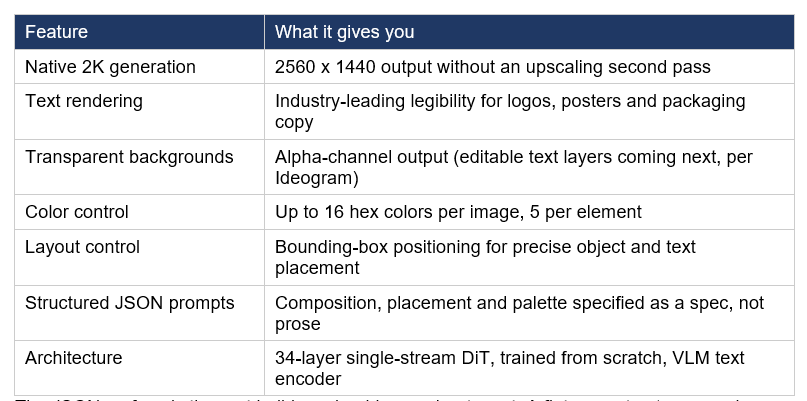
The JSON surface is the part builders should care about most. A flat prompt gets you an image; the JSON gives you repeatable control over six text bounding boxes, palettes and object positions — the difference between a one-off render and a templated design pipeline. If you're building automated content workflows, the gen-ai-experiments cookbook repo is a good place to wire JSON-prompted generation into a batch job.
Where it ranks: DesignArena and the open-weight crown
Ideogram 4.0 is the top-ranked open-weight text-to-image model on DesignArena — but it is not #1 overall, and that distinction matters. On the designer-preference leaderboard it sits first among open models and second overall, with only closed models from OpenAI and Google scoring higher. According to DesignArena results circulating at launch, it holds an Elo around 1285 with a roughly 115-point lead over the next open competitor. In the broader text-to-image arena it takes first in quality mode and around ninth overall. Translation: best-in-class if you need open weights, mid-pack if you're comparing against every closed flagship.
For the full cross-model picture and how these rankings shift week to week, the best AI models and leaderboards collection tracks where each release actually lands.
Ideogram 4.0 vs FLUX.2 vs HunyuanImage 3.0
The three names dominating the open-weight conversation in mid-2026 are Ideogram 4.0, Black Forest Labs' FLUX.2, and Tencent's HunyuanImage 3.0. They optimize for different things:
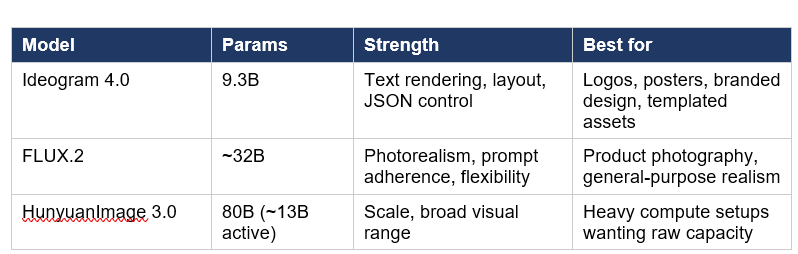
Here's my honest read: Ideogram 4.0 wins decisively on typography and design intent, lands roughly on par with FLUX on general prompts, and trails the top closed models — GPT Image, Nano Banana Pro — on raw photorealism. It is the parameter-efficient specialist, not the everything-model. If your work is text-on-image — packaging, social graphics, flyers, signage — it is arguably the best open option available right now.
The licensing catch: "open weight" is not "open source"
This is the part most launch coverage glossed over, and it changes the decision for any business. Ideogram 4.0's code is released under Apache 2.0, but the model weights themselves are governed by an Ideogram Non-Commercial Model Agreement. Researchers, hobbyists, and teams testing in non-production environments get genuine, full access — download, inspect, fine-tune, run locally. But commercial deployment requires a separate paid license. So this is open weight, not open source in the software sense where you can freely build a revenue product on top without negotiating rights.
- Free, no strings: research, learning, local experimentation, ComfyUI tinkering, fine-tuning trials.
- Needs a paid license: shipping it inside a product or any revenue-generating workflow.
How to actually run it
Ideogram 4.0 had a genuinely broad day-zero footprint, which is rare for a first open release. Your options:
- Hugging Face — nf4 and fp8 quantized checkpoints (e.g. ideogram-ai/ideogram-4-nf4) for download and local inference.
- GitHub — weights and inference code under the ideogram-oss/ideogram4 repository (Apache 2.0 code).
- ComfyUI — native day-0 support, ideal for JSON-prompted layout and palette control in a node graph.
- fal.ai — hosted deployment if you'd rather not manage GPUs.
- Ideogram web + API — three quality tiers via Ideogram's own hosted endpoints.
For local runs, the nf4 quantized checkpoint is the lowest-friction starting point. If you want to fold JSON-prompted generation into an automated pipeline, the patterns in the Build Fast with AI experiments repo translate cleanly to a ComfyUI or fal.ai backend.
My take: why this release matters more than the benchmark
The Elo score is the least interesting thing about Ideogram 4.0. The interesting thing is the strategy: a design-first company that built its moat on a closed API just handed that moat to the community. That only makes sense if Ideogram believes the defensible value has moved from the model weights to the platform, the fine-tunes, and the workflow ecosystem around them.
My contrarian point: "best open-weight model" is a quietly fragile crown. Open-weight image models are no longer scarce, and the title changes hands every few weeks — Z-Image, Qwen Image, the next FLUX point release. What won't change as fast is Ideogram's specific edge in text and layout, which is a capability lead, not a leaderboard lead. If I were betting, I'd bet on the typography moat outlasting the Elo number.
Frequently Asked Questions
What is Ideogram 4.0?
Ideogram 4.0 is a 9.3-billion-parameter open-weight text-to-image model released on June 3, 2026. It is Ideogram's first downloadable foundation model and ranks #1 among open-weight models on DesignArena, with native 2K output, strong text rendering, and structured JSON prompting.
Is Ideogram 4.0 open source or open weight?
It is open weight, not fully open source. The inference code is Apache 2.0, but the model weights fall under an Ideogram Non-Commercial Model Agreement. You can download, fine-tune, and run it freely for research and non-production use, but commercial deployment needs a separate paid license.
Is Ideogram 4.0 free to use?
Yes for non-commercial use — research, learning, and local experimentation are free once you download the weights. Commercial use requires a paid license. Ideogram's hosted web platform and API are also available across its paid plans.
How many parameters does Ideogram 4.0 have?
9.3 billion. It is a single-stream, 34-layer Diffusion Transformer trained from scratch — deliberately small and parameter-efficient compared with HunyuanImage 3.0's 80B.
Is Ideogram 4.0 better than FLUX.2 or HunyuanImage 3.0?
It depends on the task. Ideogram 4.0 leads on text rendering and design layout, lands roughly on par with FLUX.2 on general prompts, and is far smaller than HunyuanImage 3.0. For logos, posters, and text-heavy graphics it is the strongest open option; for pure photorealism, FLUX.2 and top closed models still lead.
Can I run Ideogram 4.0 locally?
Yes. nf4 and fp8 quantized checkpoints are on Hugging Face, and the inference code is on GitHub. The nf4 checkpoint is the lightest way to start on consumer hardware.
How do I use Ideogram 4.0 in ComfyUI?
ComfyUI added native day-0 support. Once weights are downloaded, you can use standard image nodes and pass structured JSON prompts to control color palettes (up to 16 hex colors), bounding-box layout, and text placement.
References
- Ideogram — Ideogram 4.0 technical blog (architecture & benchmarks)
- Ideogram — Ideogram 4.0 model page
- The Decoder — Ideogram 4.0 open-weight model with native 2K and improved text
- ComfyUI Blog — Ideogram 4.0 day-0 support: open weights and structured control
- Crypto Briefing — Ideogram 4.0 launches as the best open image model
- Startup Fortune — Ideogram 4.0 turns open weights into a startup weapon (licensing)
- Hugging Face — Ideogram model repository

