


A step-by-step guide covering skills, salary, roadmap, tools, and the exact AI workflow that 2026 PMs use to ship faster.
Sixty-three percent of product managers in 2026 switched careers to get here. If you're reading this from a software engineering, marketing, business analyst, or UX role and wondering how to make the jump — you're already closer than you think.
Product management is one of the highest-leverage roles in tech. Product managers at mid-size companies in India earn ₹18–45 LPA. Senior PMs at FAANG-adjacent companies cross ₹80 LPA. In the US, the median product manager salary sits at $136,000 — with senior roles at $180,000+. And unlike a decade ago, you don't need a Stanford MBA or a Google pedigree to get hired.
What you do need: a clear understanding of what the role actually involves, the skills that hiring managers actually test, and the AI tools that make a 2026 PM 3x more productive than a 2020 PM.
This guide covers all of it — in order, without filler.
What's in This Guide
- What does a product manager actually do?
- Types of product managers (and which one to target)
- Product manager salary in India and globally
- Skills you need to get hired as a PM in 2026
- How to become a product manager — step by step
- AI tools every product manager uses in 2026
- 5 AI prompts to practice right now
- Frequently asked questions
What Does a Product Manager Actually Do?
Most job descriptions for product managers are useless. "Drive product vision, collaborate cross-functionally, use data to make decisions" — that's every knowledge worker since 2010.
Here's what a product manager actually does on a Tuesday:
- 9 AM: Reviews analytics dashboard to understand why a feature had 40% lower engagement last week
- 10 AM: User interview with a mid-market customer who churned — extracts 3 sharp insights about onboarding friction
- 11 AM: Writes a 2-page PRD (product requirements document) for the engineering team's next sprint
- 1 PM: Roadmap review with the CTO — defends why Feature X gets priority over Feature Y using RICE scores
- 3 PM: Competitive analysis: new Salesforce feature launched yesterday, how does it affect our positioning?
- 4 PM: Stakeholder update to the VP of Sales: here's what's shipping next week, here's what's delayed and why
The job sits at the intersection of business, technology, and user experience. You're not an engineer, but you need to know enough to spec technically. You're not a designer, but you need to know when UX is the bottleneck. You're not a salesperson, but your roadmap decisions directly affect revenue.
🎯 One-line definition: A product manager decides what gets built, in what order, and why — and makes sure every team involved agrees.
The Three Core PM Responsibilities
Strip away all the job description noise and PM work comes down to three things:
- 1. Discovery — figuring out what users actually need (not what they say they need)
- 2. Prioritization — choosing which of 200 possible things to build in the next 90 days
- 3. Delivery — making sure the chosen thing ships, on time, with quality
Most PM interviews test all three. Most PM failures come from neglecting one of the three.
Types of Product Managers — Which One Should You Target?
Not all PM roles are the same. Applying to every PM opening without knowing the type is the fastest way to get rejected from all of them.
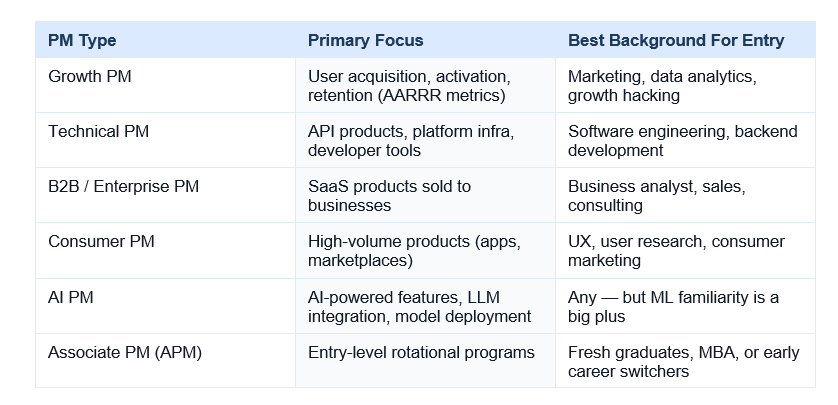
My honest recommendation for most career switchers in 2026: target B2B SaaS PM roles at Series A–C startups, or APM programs at larger companies. The hiring bar is more achievable, the learning curve is steep but navigable, and the skills transfer everywhere.
AI PM is the fastest-growing category right now. If you have any background in data or engineering and can learn to work with LLM APIs, this is the highest-leverage entry point in 2026.
Product Manager Salary: India and Global (2026 Data)
Let's be specific. Salary data is where most guides go vague. Here's what 2026 actually looks like:
Product Manager Salary in India
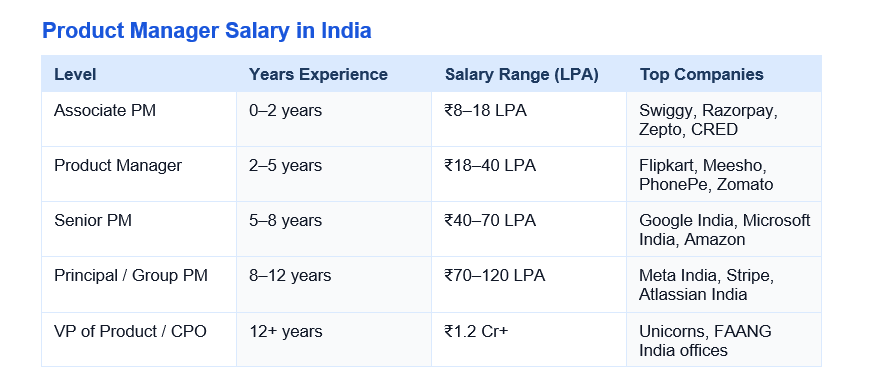
💡 Benchmark: A PM with 3 years of experience and demonstrated AI tool proficiency commands a 20–35% salary premium at product-led companies compared to traditional software firms. This premium is new since 2024 and growing.
Product Manager Salary Globally
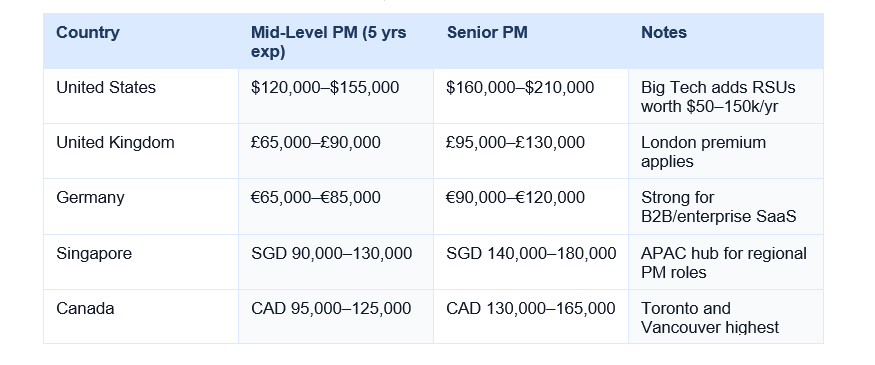
These numbers are meaningfully higher than 3 years ago. The supply of qualified PMs hasn't kept up with the demand explosion from AI-first product teams. If you can demonstrate AI fluency alongside product fundamentals, you're competing in a market where demand genuinely exceeds supply.
Skills You Need to Get Hired as a PM in 2026
I've reviewed 200+ PM job descriptions posted between January and March 2026 across Naukri, LinkedIn, and AngelList. Here's what actually shows up in the skills section of real job postings — not what career blogs tell you companies want.
Hard Skills (Tested in Interviews)
- Metrics & Analytics:
Every PM interview has a metrics question. You'll be asked to define success metrics for a feature, diagnose a drop in a KPI, or design an A/B test. Tools: SQL basics, Google Analytics, Mixpanel, or Amplitude. You don't need to be a data scientist — but you can't hide from numbers.
- PRD Writing:
Product requirements documents are the PM's primary output. You need to write them clearly, quickly, and with enough technical precision that engineers don't come back with 20 clarifying questions. Practice by writing fake PRDs for real products you use.
- Prioritization Frameworks:
RICE (Reach, Impact, Confidence, Effort), MoSCoW, ICE scoring, and Now/Next/Later roadmaps. Every PM interview asks you to prioritize a backlog. Know at least two frameworks cold.
- User Research Basics:
How to run a user interview without leading the witness. How to synthesize 15 interviews into 5 insights. How to design a survey that doesn't give you garbage data. This is tested with case questions in interviews.
- AI Tool Proficiency (New in 2026):
This is now explicitly in job descriptions. Companies want PMs who use AI tools in their daily workflow — not just "know about AI." ChatGPT for PRDs, Claude for research synthesis, Perplexity for competitive intel. We'll cover this in detail in the next section.
Soft Skills (Evaluated Throughout the Interview Process)
- Communication: Can you explain a technical decision to a non-technical executive in 3 sentences?
- Influence without authority: Can you get an engineering team to prioritize your feature when you have no direct reports?
- Structured thinking: Do you approach ambiguous problems with frameworks, or do you panic?
- Curiosity: Do you actually use products obsessively and have opinions about why things work or don't?
🔥 Hot take: Soft skills are harder to fake and take longer to develop than hard skills. If you're interviewing for PM roles and keep getting rejected at the final round, it's almost always a soft skills issue — specifically, unstructured thinking or an inability to influence skeptical stakeholders.
How to Become a Product Manager: Step by Step
This is the section most guides get wrong. They give you a vague list of "steps" that amount to: learn PM skills, apply for jobs, get hired. Here's what actually works in 2026.
Step 1: Choose Your Entry Path (Month 1)
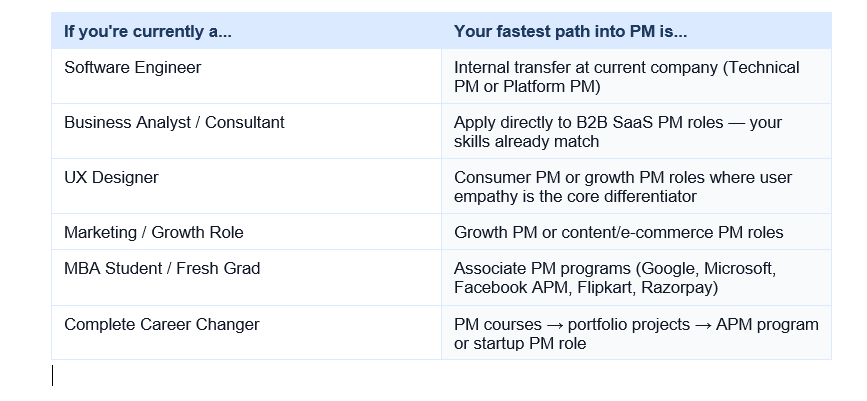
There are four realistic entry paths into PM, depending on where you're starting:
Step 2: Build Demonstrable Skills (Months 1–3)
Reading about product management does not make you a product manager. You need artifacts — documents you can show in interviews. Here's what to build:
- Write 3 fake PRDs for products you use daily. Pick a feature that doesn't exist yet, define the problem, write user stories, set metrics. Show these when asked about PM experience.
- Do 5 teardown analyses — pick 5 apps, write a 500-word breakdown of what they do well, what they don't, and what you'd build next if you were PM. Post one on LinkedIn.
- Run 3 real user interviews — find people who use a product you're analyzing, ask them questions, and synthesize findings into a 1-page research summary.
- Build a portfolio site or Notion page with all of the above. This replaces the 'PM experience' you don't have yet.
✅ The single most effective thing I've seen career switchers do in 2026: pick one real problem they face daily, treat it like a PM would (research → spec → solution), and document the entire process. That one project — done well — converts hiring managers.
Step 3: Get PM-Specific Knowledge (Month 2–3)
You don't need a PM MBA. You need targeted knowledge. In 2026, the fastest way to get it:
- Books (actually read these):
Inspired by Marty Cagan (still the definitive PM book), Continuous Discovery Habits by Teresa Torres (user research), and Escaping the Build Trap by Melissa Perri (product strategy).
- Courses with hands-on output:
Don't take courses that only give you theory. The GenAI Launchpad by Build Fast with AI is one of the few programs in 2026 that combines PM fundamentals with hands-on AI tool training — which is exactly the combo hiring managers want. Look for programs where you build something, not just watch videos.
- Communities:
Lenny's Newsletter (the best PM writing in English), Product School Slack, Mind the Product community, and LinkedIn PM groups. Read. Comment. Meet people. This is not optional networking advice — in India especially, PM hiring is heavily referral-driven.
Step 4: Get Your First PM Role (Month 3–6)
Here's the honest truth about PM job search: most PM openings on Naukri and LinkedIn are not your first PM role. They want 2–3 years of PM experience. Your job is to find the exceptions.
Where first-time PMs actually get hired:
- Series A startups (10–50 employees) who need their first dedicated PM and will trade experience for energy and AI fluency
- APM programs at larger companies — apply to all of them, every cycle, without exception
- Internal transfers — if you're at a tech company in any role, this is your fastest path
- Consulting or agency roles where you own a product workstream and can call yourself a product owner or product consultant
The application approach that works: Don't apply through the job board. Find the hiring manager on LinkedIn. Send a 4-sentence message — here's who I am, here's one specific insight about their product, here's what I'd bring, here's a link to my portfolio. 15% response rate versus 2% from job board applications.
Step 5: Nail the PM Interview (Month 4–6)
PM interviews have a predictable structure. Practice these five question types until they're reflexive:
- Product design questions: "Design a feature for X user." Framework: clarify goal → define user → brainstorm → prioritize → define metrics.
- Metrics questions: "MAU dropped 15% last week. Walk me through your investigation." Framework: verify data → segment by dimension → generate hypotheses → test.
- Estimation questions: "How many PMs are there in India?" Framework: structure the calculation, show your work, give a range.
- Prioritization: "You have 10 features and 1 sprint. What do you build?" Framework: RICE or MoSCoW, with explicit trade-off explanation.
- Behavioral: "Tell me about a time you had to influence without authority." Framework: STAR method, with specific numbers.
AI Tools Every Product Manager Uses in 2026
This is not a theoretical section. These are tools that PMs at companies like Razorpay, Swiggy, Notion, Linear, and Atlassian are actively using in their daily workflows as of Q1 2026.
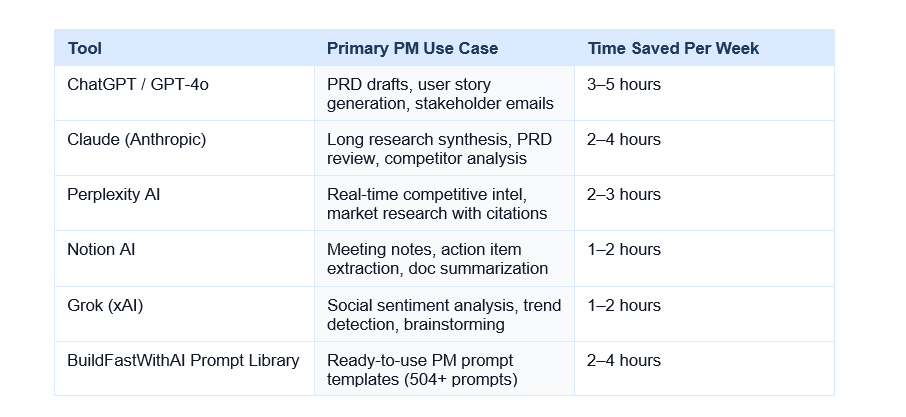
The compounding effect: a PM who uses these tools saves 10–15 hours per week on low-level documentation and synthesis work. Those hours go back into user research, strategic thinking, and stakeholder management — the work that actually determines career trajectory.
One stat worth knowing: PMs who demonstrate AI tool fluency in interviews — by showing actual artifacts produced with AI assistance — are 2x more likely to receive offers in 2026 than candidates who only talk about AI theoretically. Showing beats telling, always.
5 AI Prompts Every Aspiring PM Should Practice Right Now
The fastest way to build PM skills and AI fluency simultaneously: use these prompts with real products. Don't just read them — copy them into ChatGPT or Claude, fill in the brackets with a product you actually use, and learn from the output.
💬 Prompt 1: PRD First Draft
You are a senior product manager at a B2B SaaS company. Write a PRD for [feature] targeting [user type]. Include: Problem Statement (2 paragraphs), Success Metrics (3 specific KPIs with targets), 5 User Stories in standard format, Non-Functional Requirements, and Out of Scope items. Write in clear, direct language — no jargon.
💬 Prompt 2: Metric Drop Investigation
Act as a senior PM. Our [metric] dropped [X]% last week vs the week before. Walk me through a structured investigation: (1) How to verify the data is real, (2) How to segment the drop by [platform/geography/user cohort], (3) Top 5 hypotheses with likelihood and how to test each, (4) Recommended immediate action.
💬 Prompt 3: User Interview Synthesis
I conducted user interviews with [N] users about [topic]. Here are my notes: [paste notes]. Synthesize into: (1) Top 3 pain points with quote support, (2) Unexpected findings, (3) Patterns in language users used verbatim, (4) Top 3 product implications ranked by impact. Format as a shareable research summary.
💬 Prompt 4: Feature Prioritization
Using the RICE framework, score and rank these features: [list 5–8 features]. For each: estimate Reach (users/quarter), Impact (0.25–3 scale), Confidence (%), and Effort (person-weeks). Calculate RICE score. Flag any features where confidence is below 60% and suggest what data would increase confidence before committing.
💬 Prompt 5: Roadmap Narrative
Write a 2-paragraph roadmap narrative for [product area] for Q2 2026. First paragraph: the strategic WHY — what problem we're solving, for whom, and what outcome we're driving toward. Second paragraph: the HOW — what we're building, in what order, and why that sequence makes sense. Write for a business audience. Avoid engineering jargon.
🚀 Access 504+ PM Prompts Free
The BuildFastWithAI Prompt Library has role-specific AI prompts for every PM workflow — Product Strategy Expert, User Research Specialist, Agile Product Coach, Feature Prioritization Expert, and more. All free, organized by workflow, and ready to customize.
👉 buildfastwithai.com/tools/prompt-library
Frequently Asked Questions
How long does it take to become a product manager?
Most career switchers land their first PM role within 6–18 months of deliberately working toward it. The range is wide because it depends heavily on your starting point, how much time you dedicate to building a portfolio, and whether you target the right roles. Engineers switching internally often make the move in 3–6 months. Complete career changers typically need 12–18 months. APM programs are the fastest structured path for new graduates.
Do I need an MBA to become a product manager?
No. This was more true in 2015 than it is today. In 2026, companies — especially startups and scale-ups — care far more about demonstrated product thinking (your portfolio and how you reason through problems) than credentials. An MBA from IIM or INSEAD still opens doors at certain large companies. But it's not a requirement, and it's definitely not worth doing purely for a PM career transition if you have a tech background.
What is a product manager salary in India for freshers?
Entry-level Associate PM salaries in India typically range from ₹8–18 LPA depending on company size and city. APM programs at companies like Razorpay, Swiggy, Zepto, and CRED start at ₹12–18 LPA. Mumbai and Bengaluru command premiums over other cities. The number moves significantly upward — often 40–60% — with the first 2 years of PM experience.
What do product managers do differently in 2026 compared to 5 years ago?
Three things have fundamentally changed. First, AI tools are now core to the PM workflow — writing PRDs, synthesizing research, drafting roadmap narratives, and analyzing competitors all happen faster with AI assistance. Second, product-led growth (PLG) is now the default go-to-market for most SaaS companies, which means PMs are more deeply involved in onboarding, activation, and retention metrics than before. Third, the pace of product iteration has accelerated — shipping every 2 weeks was fast in 2020; shipping continuously with feature flags is standard now.
What are the types of product managers and which should I aim for?
The main types are: Technical PM (works on platform and API products, best for engineers), Growth PM (owns metrics like activation and retention, best for marketers and analysts), B2B Enterprise PM (sells through sales teams, great for consultants and BAs), Consumer PM (mass-market products, great for UX and consumer marketing backgrounds), and AI PM (fastest growing in 2026, building AI-powered features). For most career switchers, B2B SaaS PM or Growth PM at a startup is the most achievable first role. APM programs are the structured on-ramp.
How do I become a product manager with no experience?
The path that actually works: (1) Build a portfolio — write fake PRDs, do product teardowns, run user interviews, document your process. (2) Get PM-adjacent experience — as a business analyst, project manager, or in a product operations role. (3) Target APM programs and Series A startups, not mid-size companies with 3+ year experience requirements. (4) Network more than you apply — in India especially, most PM roles at good companies are filled through referrals. One warm introduction outperforms 50 cold applications.
Is product management a good career in India in 2026?
Yes, and the 2026 answer is more confident than the 2023 answer. The demand for AI-fluent PMs is outpacing supply significantly. Indian tech companies — Razorpay, CRED, Meesho, Swiggy, Zepto, Juspay — are scaling product teams aggressively. And Indian PMs are increasingly being hired for global roles at US and European companies who want APAC market expertise combined with strong English communication. The salary ceiling has moved up meaningfully in the last 2 years.
What to Do Right Now
If you've read this far, you're serious about making this career move. Here's what I'd do in the next 7 days:
- Pick one product you use daily. Spend 30 minutes writing down the top 3 user problems you observe. That's your first teardown.
- Use Prompt 1 from this guide to draft a PRD for a feature that would solve one of those problems. Don't edit it heavily — just see what it produces.
- Post the teardown on LinkedIn with your honest observations. It doesn't need to be perfect. It needs to demonstrate product thinking.
- Apply to one APM program you've been putting off. The application deadline passes whether you apply or not.
- Bookmark the BuildFastWithAI Prompt Library — 504 PM-specific prompts organized by workflow. Use them daily as you practice.
Product management is learnable. The skills are concrete. The path is documented. The market in 2026 is genuinely good for people who demonstrate AI fluency on top of product fundamentals.
The gap between where you are and "product manager" is not talent — it's structured effort over the next 6 months.
📚 Free Resource: BuildFastWithAI Prompt Library
504+ AI prompts for product managers, growth teams, developers, and 40+ other roles. Organized by workflow, ready to customize, completely free. Used by PMs at Razorpay, Swiggy, Zepto, and 10,000+ professionals across APAC.
👉 buildfastwithai.com/tools/prompt-library

