

Claude Tag Review: Anthropic's AI Teammate Now Lives Inside Your Slack
On June 23, 2026, Anthropic launched Claude Tag and changed the unit of AI collaboration from the individual conversation to the team channel. Instead of each person having their own private Claude session, a single Claude now joins your Slack workspace as a shared team member with its own identity, its own memory, and access to the tools and data your admin specifies. Anyone in the channel types @Claude, delegates a task, and Claude works through it in stages, posting threaded updates as it goes, while the rest of the team focuses on other things. This is not a chatbot update. It is a different paradigm for how AI works inside organizations. Andrej Karpathy called it 'significantly more inline with all other human activity org-wide.' Anthropic's own product team uses an internal version of Claude Tag to generate 65% of their code, including most of the code that built Claude Tag itself. This review covers every feature, how it compares to what came before, who can access it, what the governance model looks like, and what it actually means for teams that have been trying to integrate AI into daily workflows without friction.
1. What Is Claude Tag?
Claude Tag is Anthropic's new product that adds Claude to Slack as a persistent, shared AI teammate. It launched on June 23, 2026, in beta for Claude Enterprise and Claude Team plan customers. The core mechanic is simple: an admin adds Claude to selected channels, connects it to the tools and data sources the team wants it to have access to, and from that point on anyone in the channel can type @Claude to delegate a task. What makes Claude Tag different from any Slack bot or basic AI integration is the combination of four properties that have never existed in the same product at the same time: it is multiplayer (one shared Claude for the whole channel, not a private session per user), it has persistent memory (Claude builds context about the team's work over time without needing re-explanation), it works asynchronously (you assign a task and come back when it is done), and it can be proactive (in ambient mode, Claude monitors channels and surfaces relevant information or follows up on stalled threads without being asked). Anthropic frames Claude Tag as 'the beginning of an evolution of Claude Code.' That framing is deliberate: Claude Code is already generating $2.5 billion in annualized revenue, and Claude Tag is designed to extend the same agentic capability into the broader organizational context where most work actually happens.
For a complete picture of Anthropic's model stack and how Claude Tag fits alongside Claude Code, Cowork, and the broader Claude ecosystem, the Claude AI Complete Hub on Build Fast with AI covers every Anthropic product, model release, and capability update as they ship.
2. How Claude Tag Works: The Four Core Behaviors
Multiplayer by Design
Within a given Slack channel, there is one Claude that interacts with everyone. This is the most structurally different thing about Claude Tag compared to every AI tool that came before it. When your colleague delegates a task to @Claude and you come into the channel an hour later, you can see exactly what Claude is working on, pick up the conversation, and add context or redirect the task without starting from scratch. Work is visible, handoffs are natural, and nobody has to re-explain the situation because the context is already there, shared and visible.
Persistent Memory and Context Building
Claude Tag builds context about the team's work as it follows along with channel conversations over time. It learns the vocabulary, the ongoing projects, the recurring decisions, and the relationships between different pieces of work. If granted permission by an admin, it can also automatically pull in facts from other channels across the organization, giving it the tacit organizational knowledge that makes the difference between a generic AI response and one that actually fits your team's situation. It does not read from private channels it has not been granted access to.
Asynchronous Task Execution
Tag @Claude with a request, describe what you need, and you can close Slack and focus on other work. Claude breaks the task down into stages, executes them using whatever tools it has been connected to, and posts its results back into a Slack thread when it is done. For tasks that take hours or span multiple days, Claude Tag is designed to keep working in the background and post updates as progress is made. This is the behavior that makes it feel less like a chat interface and more like delegating work to a capable colleague.
Ambient Mode: Proactive by Default
When ambient behavior is enabled, Claude Tag moves from reactive to proactive. It monitors the channels it has access to, flags relevant information from across the organization, follows up on threads or tasks that have gone quiet without being resolved, and surfaces things the team might need to know without being asked. Anthropic's head of product for Claude Code, Cat Wu, described it this way: 'A lot of the capabilities did exist, but the form factor of being able to tag it the same way that you would a coworker is really powerful.' Ambient mode is configurable. Teams that want Claude to be purely reactive leave it off. Teams that want proactive monitoring and follow-up turn it on. The combination of ambient monitoring, persistent memory, and multi-step task execution is what makes Claude Tag behave less like a tool you open and more like a colleague who is always in the room. For developers wanting to understand the agentic patterns underlying Claude Tag, the gen-ai-experiments multi-agent and agentic workflow notebooks have working implementations of tool-using agent loops, memory systems, and async task execution directly relevant to how Claude Tag operates under the hood.
3. Claude Tag vs the Old Claude in Slack App
Anthropic first integrated Claude with Slack in October 2025 and expanded it with interactive Claude apps in January 2026. Those integrations were useful but fundamentally different from what Claude Tag ships today.
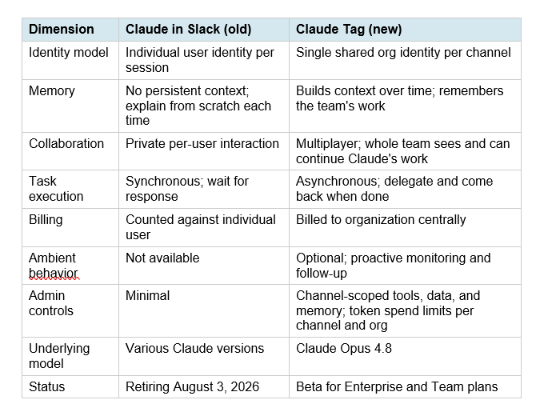
The migration from the old integration to Claude Tag is not optional in the long run. Anthropic is retiring the Claude in Slack app on August 3, 2026. Admins have a 30-day window from the Claude Tag launch to opt in and migrate. Eligible Enterprise and Team organizations receive introductory launch credits to help the whole company try Claude Tag before committing.
4. The Agent Identity Model: What Makes This Different
The most structurally significant change in Claude Tag is the shift to an agent identity model, and it is worth understanding in detail because it changes governance, billing, and collaboration dynamics simultaneously.
In the old Claude in Slack integration, when you tagged Claude it acted under your personal permissions. The tools it could access were your connected accounts. The usage billed to your personal Claude account. Every session started fresh from your context.
In Claude Tag, Claude acts under your organization's identity within a channel. The tools, data sources, codebases, and channels Claude can access in a given channel are defined by an administrator before Claude Tag starts working. Usage is billed to the organization, not to individual users. The memory and context Claude builds in a channel is shared by everyone in that channel, not owned by a single user.
This matters enormously for enterprise adoption. The single biggest adoption blocker for AI tools in large organizations has been the fragmentation problem: every employee has their own AI setup, their own context, their own prompting patterns, and there is no way to transfer institutional knowledge between them. Claude Tag's shared identity and shared memory solves this at the channel level. The context an engineer built with Claude on Monday morning is still there when a product manager enters the channel on Wednesday afternoon. It also means that sensitive boundaries are enforced architecturally rather than by trust. The Claude instance connected to the HR channel cannot access the engineering channel's memory or tools. A Claude set up for legal cannot bleed its context into the marketing channel. Isolation is admin-defined and permanent, not reliant on Claude deciding not to cross a boundary on its own. For context on how this connects to Anthropic's broader enterprise push and Claude Code's trajectory, the Claude Code review and enterprise adoption guide covers the full picture of where Anthropic is taking its agentic stack.
Hot take: the agent identity model is a bigger deal than the Slack integration itself. Other AI companies have Slack bots. Nobody else has shipped an agent identity architecture that solves shared memory, shared context, and governance isolation at the channel level simultaneously. This is the foundation for something much larger than a productivity feature.
Don't just use ChatGPT. Learn to build custom LLM agents, RAG pipelines, and full-stack Agentic AI apps in our intensive 6-week program.
5. Real Use Cases: How Teams Are Already Using Claude Tag
Anthropic's own teams have been running an internal version of Claude Tag throughout 2026. The ClaudeDevs team on X shared several concrete examples of how it is used daily, and the product team data points provide a useful baseline for what adoption actually looks like.
Software Engineering (65% of Product Code)
The most striking stat from the launch: Claude Tag's internal version now generates 65% of Anthropic's product team's code, including most of the code that built Claude Tag itself. Teams tag @Claude to write code, create pull requests, debug issues, and run analysis. The asynchronous model means engineers delegate a coding task, go do other work, and return to a PR ready for review. The context Claude has built over time means it already knows the codebase conventions, the naming patterns, and the recent decisions without being re-briefed on each task.
Product Metrics and Data Analysis
Tagging Claude to chase down product metrics is a pattern Anthropic explicitly called out at launch. Instead of a data analyst spending an afternoon building a dashboard, a product manager can tag @Claude with the metrics question, connect it to the relevant data tools, and have a structured analysis posted to the channel thread while the team continues discussing other things. The shared nature means everyone in the channel sees the analysis in context, not just the person who asked.
Support Workflows and Debugging
Support engineers are using Claude Tag to work through support tickets and find root causes of bugs. The ambient mode is particularly useful here: Claude monitors the support channel, flags patterns across multiple tickets, follows up on issues that have not been resolved within a defined period, and can propose fixes or escalation paths without being asked. For small support teams that cannot afford to let anything fall through the cracks, this is the most direct operational value the tool delivers.
Cross-Team Coordination
Because Claude Tag builds context across channels it has permission to read, it can surface connections between work happening in different parts of an organization. An engineering channel Claude that also reads the product channel can flag when a feature being built conflicts with a product decision that was made last week. A marketing Claude with access to sales data can bring relevant customer context into campaign planning discussions. These cross-channel connections are what make Claude Tag qualitatively different from a Slack bot that answers questions in isolation. For teams building AI-augmented workflows from scratch, the AI Applications and Use Cases collection on Build Fast with AI covers practical implementations across engineering, product, marketing, and support workflows.
6. Admin Controls, Security, and Privacy
Anthropic built the governance layer into Claude Tag from the start, and the controls available to administrators are more granular than what most enterprise AI tools have shipped with.
Channel-level scoping is the foundation. Each Slack channel gets its own Claude identity. Administrators specify which tools, data sources, codebases, and channels that Claude instance can access. A Claude set up for the legal team cannot access the engineering channel's tools or memory. A Claude with access to personnel data in HR stays in that context. The isolation is structural, not policy-based.
For sensitive conversations, users can also DM Claude Tag directly. In a DM, Claude operates under the user's own identity and permissions rather than the channel's shared identity, and the conversation stays private. This allows individuals to use Claude for sensitive queries without those conversations entering the shared channel context.
Token spend controls are available at both the channel level and the organization level. Administrators can set hard limits on how many tokens any given channel's Claude can consume, and organization-wide limits on total Claude Tag usage. This addresses one of the recurring enterprise concerns about AI tool cost predictability.
The ambient mode, which enables Claude to proactively monitor channels and surface information, does not access private channels that Claude has not been explicitly granted permission to read. The boundary between what Claude Tag can and cannot see is admin-defined at setup and does not change without explicit admin action.
The product runs on Claude Opus 4.8, announced in May 2026. Anthropic's standard enterprise data handling policies apply, including the options for zero data retention and HIPAA compliance that Enterprise plans include.
7. Availability, Migration, and Pricing
Claude Tag is available today in beta for Claude Enterprise and Claude Team plan customers. It is the only plan tier that gets access at launch.
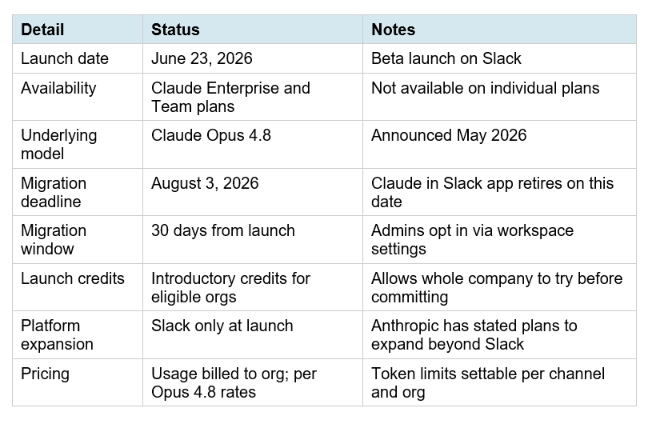
If your organization uses the existing Claude in Slack integration, migration is not optional. The current app retires on August 3, 2026. Admins need to opt in to Claude Tag within the 30-day migration window and configure channel access, tool connections, and memory scope before the deadline. Teams that delay could face a gap in Slack-based Claude access when the old integration goes offline.
8. The Bigger Picture: Why This Launch Matters
Claude Tag does not exist in isolation. It sits at the intersection of several major strategic moves Anthropic has made in the past twelve months, and understanding those moves explains why this launch is more significant than the feature announcement alone suggests.
The enterprise context is the most important frame. According to Ramp's May AI Index, which draws on corporate spending across more than 50,000 US companies, Anthropic pulled ahead of OpenAI in business adoption for the first time in May 2026, with 34.4% of firms paying for Anthropic tools against OpenAI's 32.3%. Claude Code was the primary driver. Claude Tag is designed to deepen and extend that enterprise lead from the coding workflow into every other workflow that runs through Slack.
The financial stakes behind this are significant. Anthropic raised $65 billion in a Series H in late May 2026 at a $965 billion post-money valuation. Claude Code's run-rate revenue has grown to over $2.5 billion, more than doubling since the beginning of 2026. The company filed confidentially for an IPO earlier in June. Every enterprise customer who grants Claude Tag persistent access to a Slack channel represents a dramatically stickier integration than a chatbot conversation or an API call. Usage patterns become habitual, context accumulates, switching costs rise.
The competitive landscape makes this move urgent. Microsoft is channeling organizational knowledge through Copilot and Work IQ. Snowflake and Databricks are building AI-accessible data platforms. Glean is constructing an intelligence layer between models and enterprise data. Claude Tag's answer to all of these is to live inside the conversation itself, learning from the messages where decisions actually get made. It is a bet that the richest organizational context is not in the data warehouse or the enterprise knowledge base. It is in the Slack channels where work actually happens.
Hot take: Claude Tag is the most strategically important Anthropic launch since Claude Code. Claude Code proved that agentic AI could replace a meaningful portion of software development. Claude Tag proves the same principle can work for knowledge work broadly. The 65% code generation stat is extraordinary not because of the percentage, but because it means Anthropic's own product team has demonstrated this works at scale in production, for months, before anyone else got access. That is a very different kind of launch claim than a benchmark number or a demo. For builders who want to understand how to build on top of Claude's agentic capabilities for their own teams, the Agentic AI Launchpad 2026 course covers multi-agent systems, Claude Code, tool use, and enterprise AI workflow patterns across a structured 6-week curriculum.
The only comprehensive program designed to take you from basic prompting to building interactive Artifacts, custom integrations, and deploying production-ready code with Claude Code.
Frequently Asked Questions
What is Claude Tag on Slack?
Claude Tag is Anthropic's product that adds Claude to Slack as a persistent, shared AI teammate. Launched June 23, 2026, it allows anyone in a Slack channel to type @Claude and delegate tasks. Claude works through tasks asynchronously in stages, posts results to Slack threads, builds memory of the team's work over time, and can proactively surface information in ambient mode. It is available in beta for Claude Enterprise and Team plan customers.
How is Claude Tag different from the old Claude in Slack app?
The old Claude in Slack app gave each user a private, stateless Claude session with no persistent memory and no shared context. Claude Tag gives an entire channel one shared Claude with persistent memory, an organizational identity, admin-defined tool access, and the ability to work asynchronously over hours or days. The old app is retiring on August 3, 2026. Claude Tag replaces it entirely.
Who can use Claude Tag?
Claude Tag is available in beta for Claude Enterprise and Claude Team plan customers. Individual plan users do not have access at launch. Anthropic has stated its intention to expand availability beyond the current plans and beyond Slack to other platforms over time, but no specific timeline has been announced.
What does ambient mode do in Claude Tag?
Ambient mode, when enabled by an administrator, allows Claude Tag to proactively monitor channels rather than waiting to be tagged. In ambient mode, Claude surfaces information it thinks the team needs to know, follows up on threads or tasks that have gone quiet without resolution, and flags relevant developments from across the channels it has access to. Ambient mode is optional and configurable per channel by administrators.
Is Claude Tag replacing Claude Code?
No. Claude Tag and Claude Code are complementary products. Claude Code handles deep agentic coding work through its dedicated CLI and IDE integrations. Anthropic describes Claude Tag as 'the beginning of an evolution of Claude Code': it makes Claude more proactive and brings its capabilities into the collaborative channel context where teams communicate. Engineering teams at Anthropic use both simultaneously, with Claude Tag handling channel-level delegation and Claude Code handling deeper coding sessions.
How does Claude Tag handle sensitive data and privacy?
Claude Tag's access is admin-scoped at the channel level. Each channel's Claude can only access the tools, data sources, and channels an administrator explicitly permits. Claude Tag does not access private channels without explicit permission. For sensitive conversations, users can DM Claude Tag rather than tagging it in a channel, keeping those conversations private. Token spend limits are configurable at the channel and organization level. The product runs on Claude Opus 4.8 and applies Anthropic's standard enterprise data handling policies including zero data retention options on Enterprise plans.
What is the migration deadline from Claude in Slack to Claude Tag?
Anthropic is retiring the existing Claude in Slack integration on August 3, 2026. Administrators have a 30-day window from the June 23, 2026 launch to opt in to Claude Tag and migrate their workspace. Eligible Enterprise and Team organizations receive introductory launch credits to help teams evaluate the new experience before the migration deadline. Administrators who do not migrate before August 3 will lose Slack-based Claude access when the old app goes offline.
Can Claude Tag work across multiple Slack channels?
Yes. Administrators can add Claude Tag to multiple channels, with each channel getting its own scoped Claude identity. The tools, data, and memory of one channel's Claude are isolated from another channel's Claude by default. If granted explicit permission, a Claude instance can also read from other channels across the organization to build broader organizational context, but this cross-channel access is opt-in and admin-controlled, not automatic.
What model does Claude Tag use?
Claude Tag runs on Claude Opus 4.8, Anthropic's most capable model as of its announcement in May 2026. This is the same model tier used for Anthropic's most demanding enterprise and agentic workloads. Token usage is billed to the organization at Opus 4.8 rates, with configurable spend limits per channel and per organization.
Recommended Blogs
- Claude AI Complete Hub: Models, Features, and Every
- Claude Code Review 2026: Enterprise Adoption, Benchmarks
- Anthropic Cowork Review: Claude on the Desktop
- AI Applications and Use Cases: Real Workflows Teams
- Claude Opus 4.8 Review: Benchmarks, Pricing
- Agentic AI Launchpad 2026: Build Real AI Systems in 6 Weeks
Resources & Community
Join our community of 70,000+ AI enthusiasts and learn to build powerful AI applications! Whether you're a beginner or an experienced developer, Build Fast with AI helps you understand and implement AI in your projects.
- Website — buildfastwithai.com
- LinkedIn — Build Fast with AI
- Instagram — @buildfastwithai
- Founder Twitter — @satvikps
- Twitter — @BuildFastWithAI
Agentic AI Launchpad 2026
A structured 6-week cohort program that takes you from AI basics to building and deploying real-world agentic AI systems. Includes live sessions, expert mentorship, project reviews, and a builder community network.
Ready to go from learning to building? Join the next cohort → Agentic AI Launchpad 2026
Free AI Resources
Access free tools, workshops, and micro-learning to keep building:
- AI Workshops — Free resources, upcoming events & past recordings
- Unrot — Learn AI in 5 minutes a day (free micro-learning app)
Anthropic is moving fast. Follow @BuildFastWithAI on X to stay ahead of every launch, product update, and enterprise AI development that matters for builders.
References
- Anthropic — Introducing Claude Tag
- VentureBeat — Anthropic Launches Claude Tag, Replacing
- Fortune — Anthropic Launches Claude Tag, a Tool That Works
- TechCrunch — Anthropic's Claude Tag Is Learning Your Company
- Neowin — Anthropic Introduces Claude Tag, a New AI
- Lushbinary — Claude Tag: Anthropic's Slack AI Teammate
- Cryptonomist — Anthropic Claude Tag Slack

