



.5 Pro, China's Moonshot AI dropped Kimi K3 late on July 16, a 2.8-trillion-parameter model that instantly became the largest open-weight release in history. Today also brings Xi Jinping's first-ever World AI Conference keynote, TSMC's 77 percent profit surge, a Google product rename with real features underneath, and a brain-chip milestone out of China.
Here are the 20 stories that matter for July 17, 2026, with the numbers, dates, and honest caveats. For running coverage of every release this month, bookmark our AI industry news and trends hub.
1. Gemini Day Arrives: The Make-or-Break Launch After a Full Rebuild
Google's Gemini 3.5 Pro is expected to launch today, July 17, and the reporting that surfaced this week explains the six-week delay: Google scrapped the original base model entirely and restarted pretraining after engineers found structural failures in recursive tool-calling. One caution up front: Google has never officially confirmed the date, the specs, or the pricing. Every circulating detail, including the 2-million-token context window, the Deep Think reasoning mode on the $250 Ultra tier, and pricing near $1.25 input and $10 output per million tokens, comes from leaks and third-party reporting.
The rebuilt-from-scratch story reframes the launch. On one hand it signals Google refused to ship a flawed flagship, which is the responsible engineering call; on the other, it means today carries the pressure of a do-over, landing a week after GPT-5.6 and nine days after Grok 4.5 reset the field. Grok already owns the value position at $2 and $6, as our Grok 4.5 hands-on review details, so Gemini has to win on something bigger than price. And as of last night, it also has to contend with Kimi K3 (story 2), which just planted a frontier-class open model directly in its launch window.
Three tests decide the day: whether it actually ships, whether the giant context window holds quality at full length instead of degrading past 500K tokens, and whether it beats GPT-5.6 Sol on at least one benchmark that matters. A fourth test arrived overnight: whether a closed model at $1.25 input can justify itself against an open 1-million-context rival. We will re-rank the whole field on our best AI models July 2026 leaderboard as soon as the numbers land.
2. Kimi K3 Lands Overnight: The Largest Open Model Ever Released
Moonshot AI launched Kimi K3 late on July 16, a sparse Mixture-of-Experts model with roughly 2.8 trillion total parameters and a 1-million-token context window, making it the largest open-source-track model ever released. The launch leaked a day early through a promotion page on Moonshot's own platform, and it shipped in two variants: K3 Max for chat and agent tasks, and K3 Swarm Max for large-scale parallel processing. API pricing is $3 per million input tokens and $15 output, with open weights promised by July 27, 2026.
The architecture is genuinely new, not just bigger. K3 is built on Kimi Delta Attention and Attention Residuals, which change how information flows across long sequences and model depth, and it ships with native vision plus always-on reasoning controlled by a tunable reasoning_effort parameter. Early independent estimates place it around the Opus 4.8 and GPT-5.5 tier on Artificial Analysis, competitive with top closed coding models though behind Fable 5 on some arena prompts. VentureBeat called it the largest open model ever to rival top US systems, and the launch-night chatter treated it as exactly that.
The timing is the knife twist. Moonshot dropped a frontier-class model hours before Google's biggest launch of the year, guaranteeing that every Gemini benchmark tomorrow gets compared against a Chinese model whose weights will be free within ten days. My take: this is the most aggressive product-timing move of 2026, and it works because the model is real. When the K3 weights land on July 27, the question every closed lab has dodged all year, what exactly justifies the premium, gets asked at 2.8 trillion parameters. For developers, our AI coding tools hub will track how K3 Max performs inside real coding workflows.
3. Xi Jinping Keynotes the World AI Conference for the First Time
Chinese President Xi Jinping delivers the opening keynote of the 2026 World AI Conference in Shanghai today, his first appearance in the event's history since it began in 2018. The conference runs July 17 to 20 with more than 140 forums and 1,100-plus exhibitors, and this year it doubles as a High-Level Meeting on Global AI Governance, per Bloomberg and China's foreign ministry.
The substance to watch is China's proposed World AI Cooperation Organization, an international governance body Beijing wants headquartered in Shanghai, which analysts expect Xi to define in today's speech. In plain terms, China is offering to host and convene the global rulebook for AI at the exact moment Washington has no equivalent proposal on the table. A head of state personally opening an AI trade show would have been unthinkable three years ago; today it is the logical next move in a race now fought with diplomacy as much as models.
My take: the split-screen of today is the whole year in one image. The West's biggest model launch, the East's biggest AI policy speech, and a Chinese open model dropped between them, all within 24 hours. Whoever writes the rules shapes the market every model competes in, and China just volunteered to hold the pen while its labs demonstrate they can compete on capability too. The Kimi K3 launch the night before Xi's speech was not a coincidence of calendars.
4. TSMC's Blowout Q2: Profit Up 77 Percent, $100 Billion More for Arizona
TSMC reported second-quarter net profit of roughly $22 billion, up 77 percent year over year, on revenue of $40.2 billion, up 34 percent, beating analyst expectations on sustained AI chip demand. The company raised its 2026 capital spending forecast to $60 to $64 billion, guided full-year revenue growth above 40 percent, and announced an additional $100 billion for its Arizona operations, lifting total planned US investment to $265 billion with up to four more fabs under consideration, with an emphasis on advanced 2-nanometer manufacturing.
The Arizona number is the strategic headline. A $265 billion US commitment from the company that fabricates nearly every advanced AI chip is the strongest hedge yet against the industry's Taiwan concentration risk, and it lands days after ASML's tool-price standoff exposed how narrow the supply chain's foundations are, covered in our July 16 AI news recap. Every hyperscaler compute pledge and custom-chip program, from Meta's Iris to Apple's server-silicon hunt, ultimately routes through TSMC capacity, which is exactly why the company can raise spending guidance twice in one year and have investors cheer.
The pattern of 2026 holds for another quarter: model companies cut prices while the hardware layer prints records. Grok 4.5 at $6 output, Terra at half of Fable pricing, Gemini reportedly arriving at $1.25 input, and now Kimi K3 promising free weights, all of it requires more silicon to serve more demand, and TSMC collects on every side of every price war. A 77 percent profit surge says the AI buildout is not just continuing, it is accelerating, and it is being paid for with purchase orders rather than press releases.
5. NotebookLM Becomes Gemini Notebook, and Gets a Cloud Computer
Google renamed NotebookLM to Gemini Notebook on July 16, folding its popular research tool into the Gemini brand with a new blue-and-purple gradient logo, and the rename came with real features underneath. Gemini Notebook now includes a secure cloud computer that lets users run code directly inside their notebooks for data analysis, rolling out to Pro users, and notebooks will sync across the Gemini app and Google Search, with availability inside Search's AI Mode coming. The product now serves more than 30 million people and over 600,000 organizations.
The rename matters more than renames usually do, for two reasons. First, the cloud computer turns a document-grounded chat tool into something closer to a data workbench, where you can upload sources, ask questions, and now execute analysis code against them without leaving the notebook. Second, the Search integration is a distribution event: putting notebooks inside Google Search's AI Mode places a research tool in front of billions of users the day before Gemini 3.5 Pro is expected to headline the same brand. Google is consolidating every AI surface it owns under one name in launch week, and that is strategy, not housekeeping.
The honest criticism, which Forbes captured with a piece literally titled I'm Confused, is that Google's renaming streak genuinely costs it. NotebookLM had built one of the strongest independent product brands in AI, with its podcast-style audio overviews going viral repeatedly, and folding it into the crowded Gemini umbrella risks trading distinctiveness for tidiness. My take: the features win the trade this time, since a 30-million-user research tool that can now execute code is a real upgrade, but Google should retire the rename button for a while.
6. Mira Murati's Thinking Machines Releases the Inkling Open-Weight Model
Thinking Machines, the startup founded by former OpenAI CTO Mira Murati, released Inkling, an open-weight model that anyone can download, run locally, and fine-tune. It is the company's first major public release since its heavily funded founding, and the format is the message: the executive who helped build the most famous closed models in the world chose open weights for her independent debut.
Inkling joins a 2026 open-model surge that suddenly looks like a stampede. DeepSeek, Qwen, GLM, and Kimi already held four of the top five open-weight positions, Bonsai 27B put a 27-billion-parameter model on an iPhone this week, and Kimi K3 just promised frontier-scale open weights by July 27. Every capable free model erodes the case for paying per token, and that pressure is becoming the defining business story of the year's second half. An American marquee founder joining that side of the ledger, days before two Chinese open releases bookend Google's launch, makes the trend impossible to dismiss as a China-only phenomenon.
The strategic question for Thinking Machines is what the business becomes if the model is free, and the likely answers are enterprise services, custom training, and hosted infrastructure around the open core, the same playbook Mistral has run in Europe. For teams that want to run and customize open models themselves, the fine-tuning patterns in our open-source Gen AI cookbooks are the practical starting point, and Inkling's arrival gives that toolbox one more serious option.
7. OpenAI Kills Its Atlas Browser to Focus on the ChatGPT Super App
OpenAI discontinued Atlas, its AI web browser, choosing to consolidate everything into ChatGPT as a single super app. Atlas launched as OpenAI's bid to own web navigation; its shutdown says the company now believes the chat app itself, with browsing, work tools, voice, and agents inside it, replaces the browser as the front door to the internet.
Killing a high-profile product reveals strategy better than any launch does. ChatGPT Work, GPT-Live voice, and the Codex tools now all funnel into one surface, and Microsoft reportedly reached the same conclusion this week, opting for deeper ChatGPT integration instead of building a rival browser. The interface war is consolidating fast: a year ago every lab wanted its own browser and device for each feature, and now the fight is over which single app you open first each morning. OpenAI is betting that the app with the most daily habits wins, and ChatGPT still has more of those than anything else in AI.
There is also a discipline story here worth crediting. OpenAI is weeks from an IPO filing, and shutting down a product that was not winning, rather than letting it limp along for optics, is what companies do when they start reporting to public markets. The browser was the front door of the internet for 30 years; OpenAI just said out loud that it thinks the chat app replaces it. Bold, and, judging by how much of daily work already flows through ChatGPT, probably right.
8. Microsoft Tells Sales Teams to Pitch Copilot Over OpenAI and Anthropic
Microsoft has instructed its enterprise sales teams to position Copilot as superior to OpenAI and Anthropic products, per reporting this week. That means OpenAI's largest investor and infrastructure partner is now explicitly selling against it in corporate deals, the latest consequence of the restructured Microsoft-OpenAI relationship that loosened the exclusivity between the two companies earlier this year.
The structure makes conflict inevitable. Microsoft owns a large stake in OpenAI and hosts much of its compute, yet Copilot and ChatGPT Work chase identical enterprise budgets with overlapping features, while Anthropic's roughly $47 billion in annualized revenue pressures both from the enterprise side. Partnerships in AI increasingly look like this: intertwined at the infrastructure layer, knife-fighting at the sales layer, sometimes in the same week. Every hyperscaler-lab alliance, from Google-Anthropic compute deals to Amazon's investments, carries the same fault line waiting to slip.
For businesses choosing tools, the practical effect is leverage, since competing vendors who are also partners tend to soften prices and sweeten bundles when pushed. The quiet beneficiary is Anthropic, watching its two biggest rivals argue over who sells the other's technology better while its own enterprise pitch stays undivided. My take: there are no permanent friends in AI, only permanent interests, and this sales memo is the whole industry's tangled economics compressed into one document.
9. Microsoft's Record Patch Tuesday: 570 Flaws, Found With AI
Microsoft's July 2026 Patch Tuesday fixed a record 570 security vulnerabilities across Windows and related products, the largest single patch release in the company's history, with the company crediting internal AI systems for identifying and prioritizing a significant share of them. The AI credit is the detail that turns a routine security bulletin into a signal about where software security is heading.
The number is less alarming than it looks and more revealing. AI can now audit code at a scale humans never could, which surfaces flaws that would have sat undiscovered for years, and a record patch count partly means the finding got better, not that the code got worse. The uncomfortable half of the same truth is that attackers wield the same class of tools, which is why defense has to run at machine speed. It is the same arms race behind Anthropic's Project Glasswing expansion to 150 critical organizations, and behind CISA's warning this week that AI agents are opening new gaps in identity and access management.
The practical takeaway for everyone else is unglamorous but urgent: install updates fast, because the window between a flaw being discovered and being exploited keeps shrinking as both sides automate. For the industry, a 570-flaw month is the new normal being written in real time, and security teams that have not adopted AI tooling are now structurally outpaced by attackers who have. The scary number is not the one Microsoft fixed; it is whatever number nobody has found yet.
10. Huawei Shows the Atlas 950 SuperPoD as WAIC Opens
Huawei is demonstrating its Atlas 950 SuperPoD computing system at the World AI Conference, showcasing China's most advanced homegrown AI infrastructure as the Shanghai event opens. The SuperPoD is Huawei's answer to Nvidia-class training clusters, built entirely on domestic silicon under US export restrictions, and its placement on the WAIC floor during Xi's keynote week is deliberate stagecraft.
The demo is aimed at two audiences at once: Chinese labs that need compute they cannot import, and the Global South delegations at WAIC deciding whose AI stack to build on. Paired with Xi's governance proposal and the Kimi K3 launch, the message is a full-stack pitch, with chips, models, and rules all made in China, presented as a package to countries that want AI capability without dependence on Washington's export policy. That pitch did not exist in credible form two years ago; it does now.
How close the Atlas 950 actually gets to Nvidia's top clusters is contested, and independent benchmarks of Chinese accelerators remain scarce, which deserves saying plainly. But for buyers locked out of US hardware entirely, close enough increasingly is enough, and Kimi K3 training to frontier scale inside China's compute ecosystem is the proof point Huawei's marketing needed. The hardware decoupling is no longer hypothetical; it is on the show floor in Shanghai.
11. China Reportedly Permits Limited Nvidia H200 Imports
China is reportedly allowing limited imports of Nvidia's H200 chips under government controls, a partial thaw in the hardware standoff between Washington and Beijing. The arrangement would let selected Chinese buyers access Nvidia's second-tier accelerators while Beijing keeps official pressure behind domestic alternatives like Huawei's Atlas line, which is being showcased across town at WAIC this same week.
The two-track logic is pragmatic on both sides. Chinese labs need compute now, and domestic chips, however fast they improve, cannot yet fill the whole gap at frontier-training scale; Kimi K3's 2.8 trillion parameters were not trained on wishes. Letting metered H200 supply in buys time while Huawei scales, and it gives Beijing a lever it can tighten or loosen with the geopolitical weather. For Nvidia, partial re-entry into the world's second-largest AI market recovers revenue that export rules had written off, which is why the company has lobbied for exactly this outcome all year.
The bigger lesson for anyone planning AI capacity is that chip access is now a policy variable, not a market one. Every frontier lab, on either side of the Pacific, has to model politics alongside price and power when it plans a training run, and the rules can change between the purchase order and the delivery. The US cleared license-free exports to the UAE two weeks ago, China is metering H200s in this week, and next quarter the settings may move again. Compute is sovereign now.
12. DeepSeek V4's Stable Release Puts a July 24 Deadline on Developers
DeepSeek's V4 family is targeting a mid-July stable release, with a July 24 deadline already forcing developers on preview builds to migrate. V4 has led the open-weight leaderboards since its debut, and the stable cut is what enterprises have been waiting on before moving production workloads onto it, since preview-build churn is the main thing that keeps cautious teams on paid closed APIs.
The timing stacks a second Chinese open-weight milestone into Gemini week, right behind Kimi K3, and it matters commercially because DeepSeek's roughly $0.44 per million output tokens is the price floor the entire industry gets measured against. When the stable V4 lands, the question every CFO asks gets sharper: what exactly justifies a 70x price premium for frontier closed models on routine workloads? With K3's weights also promised by July 27, the last week of July is shaping up as the open-model offensive of the year, timed to land while the closed labs are busy fighting each other.
For development teams, the practical advice is to treat the migration deadline as a forcing function for a real evaluation: run your actual workloads against stable V4, K3 Max, and your current closed model, and let the numbers decide. Our AI coding tools hub tracks where the open models genuinely hold up in real development work and where they still fall short, and the honest answer remains task-dependent. But the gap keeps narrowing, and the price gap does not.
13. Neko Health Raises $700 Million for AI Preventive Care
Neko Health, the preventive-healthcare startup co-founded by Spotify founder Daniel Ek, raised a $700 million Series C at a valuation near $7 billion to fund its US expansion, starting with clinics in New York. The company pairs full-body scans with AI analysis to catch conditions early, operates 8 clinics today, and has more than 350,000 people on its waiting list, a queue that is the clearest product-market-fit signal in consumer health AI.
The model flips healthcare's usual script: instead of treating you after symptoms appear, scan regularly, let AI compare you against your own baseline, and catch issues while they are small and cheap to address. A third of a million people queued and paying for that proposition suggests demand for catch-it-early medicine massively outstrips supply, and AI analysis is the only thing that makes reviewing millions of scans economically possible. At $7 billion, investors are betting this becomes a category, not a curiosity, and the US launch is the test that decides it.
The honest caveats deserve equal weight. Preventive whole-body scanning is genuinely debated in medicine, because it can surface false positives that trigger anxiety and unnecessary procedures, and AI analysis is only as good as its clinical validation, which the US market will scrutinize harder than anywhere on Earth. Between Neko's raise, Hemispheric's brain-analysis round, and the implant news in story 14, health is quietly becoming AI's most consequential frontier, and also its most regulated one. That combination will produce both breakthroughs and backlash, likely in the same quarter.
14. China Announces the First Commercial Invasive Brain-Chip Implant
China has completed what it describes as the first commercial invasive brain-chip implant, moving brain-computer interfaces from clinical trials toward market deployment while Western efforts like Neuralink remain in testing. Details are limited and independently unverified, which deserves stating plainly before any analysis, but the claim itself marks a threshold the field has been approaching for years.
The word commercial is the milestone. Trials are science; commerce is scale, and a market for implanted neural interfaces opening anywhere resets the timeline everyone assumed for the technology. The therapeutic upside is enormous and real, since brain-computer interfaces can restore communication and control for people with paralysis and neurological conditions, letting thought drive cursors, prosthetics, and speech devices. If China has genuinely moved first to commercial deployment, it will accumulate the real-world neural data and surgical experience that the whole field needs, and that lead compounds.
The privacy stakes are the deepest technology has ever faced, because neural data is as personal as data can possibly get, and a commercial market for it now apparently exists somewhere in the world ahead of any meaningful regulatory framework. Pair this with Hemispheric's $52 million brain-analysis round from earlier in the week and the direction is unmistakable: the line between AI and biology is dissolving faster than the rules governing it are being written. This is the story from this week that people will still be discussing in five years.
15. India's Emergent Hits Unicorn Status With a $130 Million Round
Indian AI startup Emergent raised $130 million in Series C funding at a $1.5 billion post-money valuation, reaching unicorn status with $230 million raised in total. Emergent's platform lets users build full applications by describing them in natural language, no traditional programming required, placing it in the fast-growing vibe-coding category that every major lab is also chasing.
The location matters as much as the product. India has the world's largest developer population and a massive digital economy, and a homegrown unicorn in natural-language app building signals the AI product race widening beyond Silicon Valley and Beijing. The category thesis is that the next hundred million people who build software will mostly not be professional developers, and tools priced and localized for emerging markets are positioned for exactly that population. Emergent understands Indian pricing, Indian languages, and Indian distribution in ways a San Francisco competitor structurally does not.
The competitive reality is that Emergent faces giants, since OpenAI, Google, and every coding-tools startup are converging on the same describe-an-app dream, and platform players can bundle it for free. But local moats in emerging markets have repeatedly beaten global bundles, from payments to commerce, and the sheer scale of India's builder population gives a focused local player room to win big even against subsidized competition. The most exciting thing in AI right now is not another frontier model; it is who gets to build software next.
16. Asia Venture Funding Hits a Multiyear High
Asian startup venture funding reached a multiyear high in Q2 2026, with fintech funding up 23 percent despite fewer total deals, and AI driving the concentration. The regional surge complements the US picture, where 86 percent of the $412.7 billion in H1 venture money went to AI, covered in our July 15 AI news recap, and it confirms that the capital side of the AI boom is now genuinely global.
The through-line this week is unmistakable: Emergent's Indian unicorn round, Zeroth's Ant-led robotics raise, Korea's $880 billion state plan, Kimi K3 out of Beijing, and now a regional funding high. The AI capital map is multipolar for the first time, with sovereign wealth, corporate venture arms, and regional funds all writing checks that used to come only from Sand Hill Road. For founders outside the US, this is the best fundraising environment in a decade; for the US ecosystem, it is the end of an effective monopoly on AI capital formation.
The strategic consequence is that the next generation of AI companies will be built for and funded by their home markets first, which changes what gets built. Tools for Indian small businesses, Chinese industrial robots, Korean chip infrastructure, and Gulf compute campuses are all being funded at scale simultaneously, and none of them need Silicon Valley's permission. The assumption that the interesting cap tables all sit in California expired sometime this year, and Q2's numbers are the death certificate.
17. AI Security M&A Triples as Buyers Rush to Secure Agents
Cybersecurity companies completed 219 mergers and acquisitions in the first half of 2026, on pace for more than 400 for the year, and acquisitions of AI security companies specifically jumped from 10 in all of last year to 29 in the first half alone. Strategic buyers are hunting companies that can secure AI models and autonomous agents, the fastest-emerging attack surface in enterprise software.
The tripling tracks a real and widening gap: enterprises are deploying agent fleets faster than anyone can secure them, and CISA warned this week that AI agents are creating new holes in identity and access management. Every agent with credentials and autonomy is effectively a new employee who never sleeps, can be socially engineered at machine speed, and inherits whatever permissions it was carelessly granted. The market has concluded that securing that is easier bought than built, and the acquirers are paying up accordingly.
For the security industry this is the biggest product cycle since cloud migration, and for enterprises the practical checklist is forming fast: inventory every agent with credentials, scope permissions to the minimum, log every action, and put human checkpoints in front of anything irreversible. The week's enterprise-agent launches from Google, Meta, and Nvidia all lead with governance features for exactly this reason. Expect the 29 acquisitions to look small by December, because the attack surface is compounding monthly.
18. Hundreds of Experts and the UN Press for Global AI Governance
Hundreds of AI experts issued a public warning that the world must prepare now for AI's economic and social impact, while the UN pressed its own push for global governance amid expert warnings of potential catastrophic harm. The calls land, by coincidence or not, in the same week China formally proposes its World AI Cooperation Organization at WAIC, turning governance from a panel topic into a live geopolitical contest.
The governance vacuum is becoming the story underneath every other story. National efforts are fragmenting, with the EU building pre-market testing with ENISA, the US convening Fed task forces and Senate hearings, and China proposing to host the global body, while the technology ships weekly and labs walk back their own safety commitments, per the Future of Life index. The experts' point is uncomfortable but simple: every previous technology got its rules after the harm arrived, and AI is moving too fast for that pattern to be survivable.
The realist read on today is that governance follows power, and power is being demonstrated on both sides of the Pacific this very week, in models, chips, and capital. Whether Xi's Shanghai speech advances real coordination or just relocates the argument to a Chinese-hosted venue is the open question, and the West's lack of a counter-proposal is itself a policy choice with consequences. The experts are right that the window is narrow; the harder truth is that nobody with leverage is currently rushing to close it.
19. Google Opens Android to Rival App Stores Starting July 22
Google will allow competing app stores to distribute through Google Play starting July 22, ending its long fight with Epic Games, while charging marketplace operators annual security review fees. The settlement reshapes Android's distribution economics just as AI apps become the store's hottest and highest-revenue category.
The AI angle is distribution, and it is bigger than it first appears. Alternative app stores mean alternative channels for AI assistants, agents, and model marketplaces that previously lived under Google's terms and Google's 30 percent cut, and every major lab now has a consumer app whose economics improve the moment a cheaper channel exists. For AI companies whose products compete directly with Gemini, a side door into more than two billion Android devices opening the same week Gemini 3.5 Pro launches is timing worth savoring, and worth exploiting.
The security-fee structure is Google's hedge, keeping it as the toll collector even on rival storefronts, and it will be fought over immediately. But the direction is set: the app store duopoly is loosening exactly as AI becomes the main thing people install, which redistributes leverage from platform owners to app makers at the best possible moment for the labs. Watch whether OpenAI, Meta, or Perplexity announces a store presence of its own; the incentive now exists.
20. What to Watch Tonight: The Gemini Verdict and the Xi Speech
Two events tonight will set the agenda for the rest of July: whether Gemini 3.5 Pro actually ships and how it benchmarks, and what Xi Jinping commits China to in Shanghai. For Gemini, the tells are the context-window quality at full length, the Sol comparison on coding, whether the leaked $1.25 pricing survives contact with reality, and now how it stacks against Kimi K3's overnight numbers. For the speech, the tell is specificity, since a named World AI Cooperation Organization with a headquarters and founding members is diplomacy, while anything less is theater.
The stakes compound because the stories converged this week into one story: the model race, the chip race, and the rules race now share a calendar, and July 17 is the day they share a stage. Kimi K3's launch timing, Huawei's show-floor demo, the H200 import thaw, and Xi's keynote are a coordinated demonstration that China competes at every layer, while Gemini, TSMC's Arizona billions, and the West's funding concentration are the other half of the split screen. Neither side gets to win a layer in isolation anymore.
Tomorrow's recap will carry the verdicts: the Gemini benchmarks if they land, the K3 independent numbers as they firm up, and whatever Shanghai announces. If today delivers half of what it promises, this becomes the most consequential single day in AI since GPT-5.6 launched, and possibly since the year began. Set an alert, or just let us read it all for you overnight.
The July 17 Frontier Scoreboard: The Field Gemini Enters
As of this morning, here is the frontier field Gemini 3.5 Pro is expected to join tonight, on price and status, with Kimi K3 freshly added after its overnight launch.
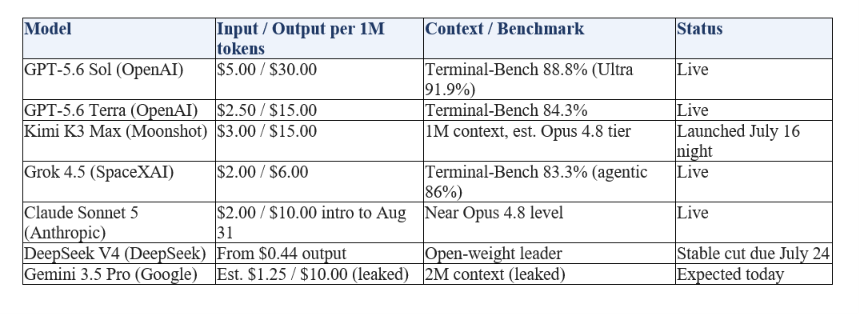
Leaked specs, launch-night estimates, and launch-week claims all deserve independent verification, and this table gets rewritten tonight.
Frequently Asked Questions
What is Kimi K3?
Kimi K3 is Moonshot AI's flagship model launched late on July 16, 2026, a sparse Mixture-of-Experts system with roughly 2.8 trillion total parameters, a 1-million-token context window, native vision, and always-on reasoning. It shipped as K3 Max and K3 Swarm Max at $3 input and $15 output per million tokens, with open weights promised by July 27, making it the largest open-track model ever released.
Is Gemini 3.5 Pro launching today?
July 17, 2026 is the widely reported target, but Google has never officially confirmed the date, specs, or pricing. Leaked details point to a 2-million-token context window, Deep Think reasoning on the $250 per month Ultra tier, and API pricing near $1.25 input and $10 output per million tokens, all pending official confirmation.
Is NotebookLM now called Gemini Notebook?
Yes. Google renamed NotebookLM to Gemini Notebook on July 16, 2026. It remains the same standalone research tool, now with a secure cloud computer that runs code inside notebooks for Pro users, syncing across the Gemini app and Google Search. The product serves more than 30 million users and 600,000-plus organizations.
Why is Xi Jinping speaking at the World AI Conference?
Xi is delivering the opening keynote of the 2026 World AI Conference in Shanghai, his first appearance since the event began in 2018, signaling that China treats AI leadership as a top national priority. He is expected to detail China's proposed World AI Cooperation Organization, a global governance body Beijing wants headquartered in Shanghai.
How much profit did TSMC make in Q2 2026?
TSMC posted a Q2 net profit of roughly $22 billion, up 77 percent year over year, on revenue of $40.2 billion, up 34 percent, driven by AI chip demand. It raised 2026 capital spending to $60-64 billion and added $100 billion to its Arizona expansion, bringing planned US investment to $265 billion.
Why did OpenAI shut down its Atlas browser?
OpenAI discontinued Atlas to concentrate everything into ChatGPT as a single super app spanning browsing, work tools, voice, and agents. The move reflects a strategic belief that the chat app, not the browser, becomes the primary interface to the internet, and it streamlines the product line ahead of OpenAI's expected IPO filing.
Did China really do a commercial brain-chip implant?
China announced completion of what it calls the first commercial invasive brain-chip implant, a claimed move from clinical trials toward market deployment. Details remain limited and independently unverified, but it marks a significant claimed milestone while Western efforts like Neuralink remain in trials.
When do Kimi K3's open weights release?
Moonshot AI has promised Kimi K3's open weights by July 27, 2026, roughly ten days after the July 16 API launch. Combined with DeepSeek V4's stable release targeting July 24, the last week of July is set to be the biggest stretch for open-weight AI this year.
Recommended Blogs
● AI News Today July 16 2026: 15 Biggest Stories
● AI News Today July 15 2026: 15 Biggest Stories
● AI News Today July 14 2026: 15 Biggest Stories
● Best AI Models July 2026: Full Ranked Leaderboard
● Grok 4.5 Review: xAI's Coding Model Tested
Resources & Community
Join our community of 70,000+ AI enthusiasts and learn to build powerful AI applications! Whether you're a beginner or an experienced developer, Build Fast with AI helps you understand and implement AI in your projects.
● Website - buildfastwithai.com
● LinkedIn - Build Fast with AI
● Instagram - @buildfastwithai
Agentic AI Launchpad 2026
A structured 6-week cohort program that takes you from AI basics to building and deploying real-world agentic AI systems. Includes live sessions, expert mentorship, project reviews, and a builder community network.
Ready to go from learning to building? Join the next cohort → Agentic AI Launchpad 2026
Free AI Resources
Access free tools, workshops, and micro-learning to keep building:
● AI Workshops - Free resources, upcoming events & past recordings
● Unrot - Learn AI in 5 minutes a day (free micro-learning app)
Tonight brings the Gemini verdict, the K3 benchmarks, and the Xi speech, and tomorrow's recap will carry all three. Follow Build Fast with AI and subscribe so it lands before your standup.
References
● VentureBeat — Moonshot AI Releases Kimi K3, Largest Open Model Ever
● MarkTechPost — Kimi K3: 2.8T Open MoE With Delta Attention and 1M Context
● Google Blog — NotebookLM Is Now Gemini Notebook
● TechCrunch — Google Renames NotebookLM to Gemini Notebook
● Bloomberg — Xi to Debut at China's Flagship AI Summit
● TechTimes — Gemini 3.5 Pro Targets July 17 After Full Rebuild
● Tech Startups — Top Tech News Today, July 15-16 2026

