


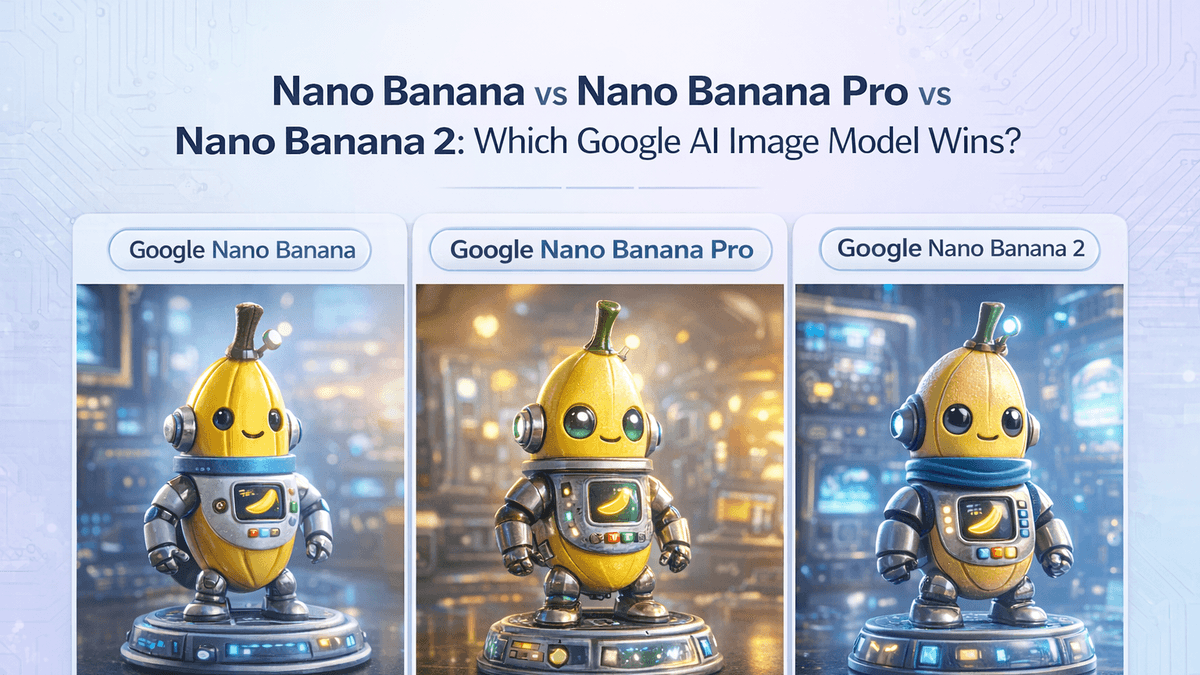
Nano Banana vs Nano Banana Pro vs Nano Banana 2
5 billion images. That's how many people generated with the original Nano Banana in under two months after its August 2025 launch. I don't think anyone - including Google - saw that coming.
I've been following the Nano Banana story since day one, when a mysteriously named anonymous model started absolutely wrecking every other image generator on LMArena and nobody knew who built it. Spoiler: it was Google all along. And now, less than seven months later, we're on the third iteration of this model family.
So here's the real question: which version should you actually use in 2026? Nano Banana (the OG), Nano Banana Pro (the studio-grade upgrade), or Nano Banana 2 (the one that just replaced Pro as the Gemini default)? The answer isn't as obvious as Google's marketing makes it sound.
I broke down every meaningful difference - speed, resolution, pricing, real-world quality, and who each model is genuinely built for. Let's get into it.
1. The Nano Banana Story: From Viral Mystery to Google's Default
The Nano Banana origin story is genuinely one of the most unusual AI launches ever. In late July 2025, Google quietly submitted an anonymous model to LMArena - the crowdsourced AI evaluation platform - under the codename "Nano Banana." The name came from a late-night scramble; one team member's nickname was "Nano," another's was "Banana." Pure accident. Pure gold.
The model went viral before Google even confirmed it was theirs. People couldn't believe what they were seeing: character consistency at 95%+ accuracy, generation times of 1–2 seconds, and photo-realistic editing that made DALL-E 3 and Midjourney look dated. Social media lost it - and the banana emoji became Google's unofficial mascot for the whole thing.
📊 Key Stat
Nano Banana attracted 13 million first-time users to the Gemini app in just 4 days after launch (September 2025). By mid-October 2025, it had generated over 5 billion images globally, with India emerging as the #1 country for usage. (Source: Google DeepMind, TechCrunch)
Google officially launched Nano Banana (technically: Gemini 2.5 Flash Image) on August 26, 2025, after weeks of viral underground adoption. The figurine trend - turning selfies into 3D toy-like renderings -started in Thailand and exploded globally. The "AI saree" trend in India, where users generated vintage-style portraits in traditional attire, became a cultural phenomenon. By September 15, Gemini had added 23 million total new users.
Then came Nano Banana Pro (Gemini 3 Pro Image) in November 2025 -the studio-quality leap forward. And on February 26, 2026, Google dropped Nano Banana 2 (Gemini 3.1 Flash Image), which immediately became the default model across the entire Gemini app, replacing Pro for all users.
My hot take: The codename strategy was either the luckiest accident or the most brilliant guerrilla marketing in tech history. No press release could have generated the genuine excitement that came from watching people discover "Nano Banana" organically on LMArena and share their disbelief online.
2. Nano Banana vs Nano Banana Pro vs Nano Banana 2: Full Comparison Table
Before I get into the nuances of each model, here's everything that matters in one place. I'll unpack each row in the sections below.
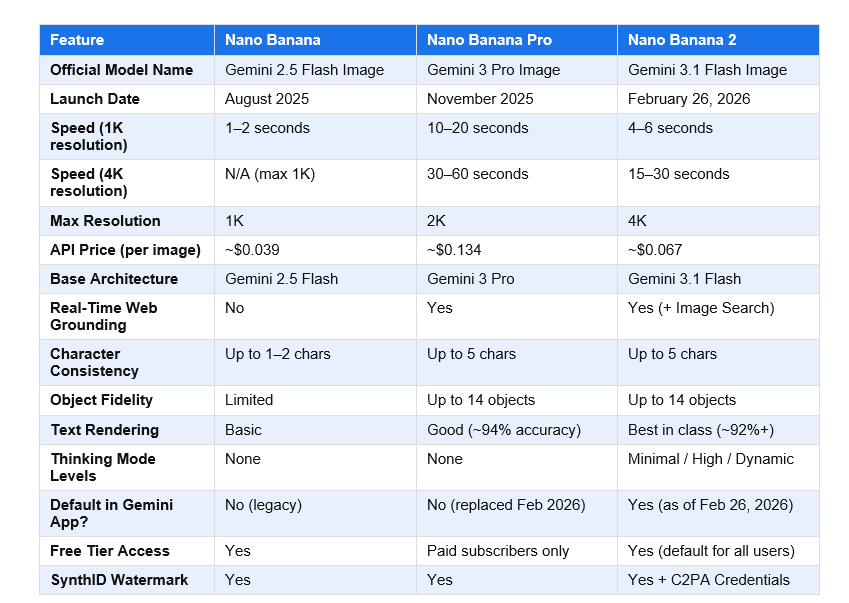
Table: Full feature comparison across all three Nano Banana models as of March 2026. Pricing from Google Gemini API official docs.
3. Nano Banana (Gemini 2.5 Flash Image): Still Worth Using?
The original Nano Banana is Gemini 2.5 Flash Image, officially released August 26, 2025. It's the model that started everything - and for its time, it was genuinely revolutionary.
At launch, it beat every competitor on the LMArena leaderboard for image editing. 95%+ character consistency. 1-2 second generation times. It was free to use (100 edits/day on the free tier), available globally from day one, and priced at roughly $0.039 per image via API. For developers building consumer apps, that was a steal.
What Made It Special
- Subject consistency: Same person recognizable across multiple edits and poses
- Multi-image fusion: Combines multiple photos into one seamless output
- World knowledge: Context-aware edits based on real-world understanding
- SynthID watermarking: Invisible AI provenance marking baked in from day one
- Speed: 1-2 second generation at 1K resolution — competitors averaged 10–15 seconds
Where It Falls Short (Now)
Honestly? At this point, the original Nano Banana is mostly a historical artifact. Its 1K resolution ceiling is a hard limitation for professional work. It has no real-time web grounding. And both Pro and NB2 outperform it in every quality metric.
I'd only recommend still using the original if you're accessing an older API integration that hasn't been updated, or if you're doing extremely high-volume, low-quality-threshold work where $0.039/image matters vs $0.067 for NB2.
💡 Quotable Insight
The original Nano Banana proved that AI image generation could be fast AND good simultaneously — before it, the assumption was you could only have one.
4. Nano Banana Pro (Gemini 3 Pro Image): The Studio Workhorse
Nano Banana Pro is Gemini 3 Pro Image, released November 2025. This is where Google stopped playing around and made something genuinely professional.
Built on Gemini 3 Pro -Google's flagship reasoning model -Pro "thinks" through the entire image generation process. It considers spatial relationships, lighting physics, composition rules, and creative intent before rendering a single pixel. The difference is visible, especially on complex prompts.
Pro's Genuine Strengths
- Character consistency across 5 characters: Essential for storyboards, brand assets, and serialized content
- Object fidelity up to 14 items: In a single workflow — genuinely useful for product mockups
- Maximum image quality: Richer textures, more natural lighting, superior spatial composition at 2K resolution
- Complex prompt intelligence: ~94% accuracy on text rendering, outperforms NB2 on specialized instructions
- Studio creative control: Masked editing, lighting changes, multi-image blending with fewer artifacts
The Honest Downsides
Pro is slow by modern standards. 10–20 seconds per image at 1K resolution, 30-60 seconds at 2K. For an API-driven product doing hundreds of images daily, that compounds into real UX problems. It's also the most expensive option at ~$0.134/image - nearly double Nano Banana 2 for most use cases.
The other thing I'd flag: Pro doesn't have Image Search Grounding or Thinking Mode, both of which NB2 ships with. It's a strange gap for a "Pro" product to have fewer features than its successor on two metrics that matter for editorial accuracy.
🔥 Hot Take
Nano Banana Pro is still the best Google image model for anyone delivering final campaign assets where maximum quality justifies the cost and wait. But calling it 'Pro' while NB2 has features Pro doesn't? That's a branding problem Google hasn't addressed.
Google kept Pro accessible for Gemini AI Pro and Ultra subscribers after NB2 launched - you can still trigger it via the three-dot "Regenerate" menu. Smart move. People doing professional work need that ceiling available, even if NB2 handles 90% of their workflow.
5. Nano Banana 2 (Gemini 3.1 Flash Image): Best of Both Worlds?
Google describes Nano Banana 2 as combining the "advanced world knowledge, quality, and reasoning of Nano Banana Pro at lightning-fast speed." That's a strong claim. Based on independent testing, it's largely accurate - with a few caveats worth knowing.
Nano Banana 2 is Gemini 3.1 Flash Image, launched February 26, 2026. It's now the default model across the Gemini app (Fast, Thinking, and Pro modes), Google Search AI Mode, Google Lens, and Flow, the AI video/creative studio.
What NB2 Gets Right
- Speed: 4–6 seconds at 1K resolution (vs 10–20s for Pro), 15-30 seconds at 4K (vs 30–60s for Pro)
- 4K resolution ceiling: Beats Pro's 2K max - this alone is significant for print and large-format work
- Image Search Grounding: Retrieves real reference images from Google Search during generation — dramatically improves accuracy for real-world landmarks, logos, specific products
- Thinking Mode: Three levels (Minimal, High, Dynamic) - developers can tune the speed/quality tradeoff per request
- Text rendering: Handles complex Chinese layouts and multilingual advertising graphics better than Pro in real-world tests
- Price: ~$0.067/image at Flash tier - roughly 50% cheaper than Pro
Where Pro Still Wins
Character consistency on complex, multi-element prompts still slightly favors Pro. Beebom's hands-on comparison found NB2 superior in most areas, but acknowledged Pro's edge on highly precise, structured studio-level outputs.
Geeky Gadgets testing showed NB2 excels at cinematic realism and lifelike textures, while Pro maintains more consistency on character appearance across multiple scenes - critical for brand identity work where uniformity across a 20-piece campaign matters more than raw realism.
📊 Benchmark
In Google's internal Elo preference evaluations, Nano Banana 2 outperformed GPT-Image 1.5 (OpenAI), Seedream 5.0 Light (ByteDance), and Grok Imagine Image (xAI) on overall visual quality, infographic clarity, and factual accuracy. (Source: Google DeepMind, February 2026)
My overall read: NB2 is the best all-around choice for 90% of real use cases. The 10% where Pro still wins is specifically ultra-high-precision brand creative at maximum quality where you need every pixel deliberate and budget isn't the constraint.
6. Speed & Performance: The Numbers That Actually Matter
Speed comparisons between AI image models are often cherry-picked. Here are the consistent numbers across independent tests:
- Nano Banana at 1K: 1-2 seconds (original benchmark from Aug 2025; competitors averaged 10–15s at the time)
- Nano Banana Pro at 1K: 10-20 seconds
- Nano Banana Pro at 2K: 30-60 seconds
- Nano Banana 2 at 1K: 4-6 seconds
- Nano Banana 2 at 4K: 15-30 seconds
The 3–5x speed advantage of NB2 over Pro is transformative for API-driven products. If you're running a workflow that generates 500 images per day with Pro, you're sitting on roughly 70-200 minutes of generation time. With NB2, that drops to 33-50 minutes. At scale, that's the difference between a product feeling snappy and feeling broken.
One thing that surprised me: NB2's 2K default resolution in the Gemini app is actually a step up from Pro's previous 1K default. So for regular Gemini users, NB2 didn't just replace Pro - it replaced Pro with a higher-resolution, faster default. That's a genuine upgrade for free-tier users.
💡 Quotable Insight
NB2 at 4K still generates images faster than Pro at 2K. Resolution is no longer a speed trade-off with Google's image models.
7. Pricing Breakdown: What You'll Actually Pay
Pricing matters more at scale than in isolation. Here's what the numbers look like in practical terms:
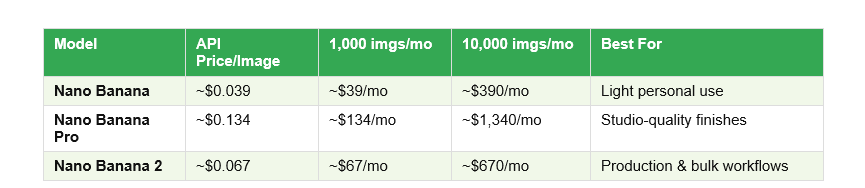
Pricing as of March 2026 via the Gemini API. Free-tier Gemini app users access NB2 at no cost. Source: Fello AI, apiyi.com.
A hybrid tiered workflow is the smartest approach for production teams: use NB2 at 0.5K or 1K for ideation and drafts, NB2 at 2K for refinement, and Pro at 4K only for final hero assets. Independent analysis from apiyi.com suggests this approach can reduce total generation costs by up to 42% without compromising quality at the stages that matter most.
My contrarian point here: the price gap between NB2 and the original Nano Banana is smaller than people expect. You're paying about 72% more per image for NB2 vs the original. But NB2 gives you real-time web grounding, 4K resolution, faster speed, and better language support. The original is basically a worse product at a slightly lower price. Unless you're doing 100,000+ images/month, the original no longer makes financial sense.
8. Which Model Should You Use? My Honest Take
I'm not going to hedge this. Here's exactly who should use what:
Use Nano Banana 2 if:
- You're a regular Gemini user (it's already your default - no action needed)
- You're a developer building an app that generates images at volume
- You need real-time accuracy for specific products, brands, or locations (Image Search Grounding is exclusive to NB2)
- You create multilingual content - especially Asian languages or global ad campaigns
- You want 4K output without paying Pro prices or Pro wait times
- You're doing storyboards, product mockups, or brand visuals with up to 5 characters
Still Use Nano Banana Pro if:
- You're delivering final campaign hero assets at maximum quality and budget isn't the concern
- You need the highest possible character consistency across a large, complex visual project
- You're a Google AI Pro or Ultra subscriber and precision matters more than speed
- You've tested both models with your specific prompts and Pro's outputs are materially better for your use case
Skip the Original Nano Banana if:
- You have access to NB2 (i.e., basically everyone now - it's the Gemini default)
- You're doing any professional work - the 1K resolution ceiling is a hard blocker
🔥 My Final Take
Nano Banana 2 is objectively the best default image model Google has ever shipped. It's faster than Pro, cheaper than Pro, generates at higher resolution than Pro, and has features Pro doesn't have. The only reason to reach for Pro in 2026 is if you're doing studio-level work where maximum quality at maximum price is an intentional, reasoned decision - not just because 'Pro sounds better.'
9. FAQ: Nano Banana vs Nano Banana Pro vs Nano Banana 2
Q1: What is Nano Banana exactly - is it part of Gemini?
Yes. "Nano Banana" is the brand codename for Google's image generation model family, all built on Gemini's underlying architecture. The original Nano Banana is officially Gemini 2.5 Flash Image, Nano Banana Pro is Gemini 3 Pro Image, and Nano Banana 2 is Gemini 3.1 Flash Image. The "Nano Banana" name came from a codename used during secret public testing on LMArena in August 2025 and stuck after going viral.
Q2: Is Nano Banana 2 better than Nano Banana Pro?
For most use cases, yes. Nano Banana 2 is 3-5x faster, 50% cheaper, supports 4K resolution (vs Pro's 2K ceiling), and includes exclusive features like Image Search Grounding and Thinking Mode that Pro doesn't have. Pro retains an edge in maximum quality for complex, highly detailed studio prompts - but NB2 outperforms Pro in head-to-head testing on infographics, text rendering, and real-world accuracy.
Q3: Can I still use Nano Banana Pro after Nano Banana 2 launched?
Yes. Google AI Pro and Ultra subscribers retain access to Nano Banana Pro via the "Regenerate with Nano Banana Pro" option in the three-dot menu of any generated image in the Gemini app. At the API level (AI Studio, Gemini API, Vertex AI), both models remain independently accessible - NB2 via gemini-3.1-flash-image-preview and Pro via gemini-3-pro-image-preview.
Q4: What is the technical model name for Nano Banana 2?
Nano Banana 2's official technical name is Gemini 3.1 Flash Image. The API model string is gemini-3.1-flash-image-preview. It was launched on February 26, 2026 and became the default image generation model across the Gemini app, Google Search AI Mode, Google Lens, and Google Flow on the same day.
Q5: How much does Nano Banana 2 cost per image via the API?
Nano Banana 2 costs approximately $0.067 per image at Flash tier, priced at $60 per million tokens via the Gemini API. A 0.5K ultra-low-cost tier is also available. This is roughly 50% cheaper than Nano Banana Pro (~$0.134/image at $120/million tokens). For enterprise teams, running 1,000 images per month with NB2 costs ~$67/mo vs ~$134/mo with Pro - saving $804/year at equivalent quality.
Q6: Why does Google call it 'Nano Banana 2' instead of 'Nano Banana Flash' or something clearer?
Honestly, the branding is a bit confusing. "2" implies a direct generational successor to the original Nano Banana, but the model is architecturally more of a sibling to Pro (they launched 3 months apart) on a faster base. Google has leaned into the banana emoji branding as a consumer identity, and the "2" signals a mainstream iteration that's accessible to everyone - which is exactly what it is. Whether the naming will remain consistent for future versions is an open question.
Q7: Does Nano Banana 2 add SynthID watermarks to every image?
Yes. Every image generated by Nano Banana 2 includes both a visible SynthID watermark and an invisible embedded watermark plus C2PA Content Credentials - a new addition compared to earlier models. C2PA is an industry standard developed with Adobe, Microsoft, OpenAI, and Meta that provides metadata about how an image was created. As of March 2026, Google plans to bring C2PA verification to the Gemini app soon. The SynthID verification feature has already been used over 20 million times since November 2025.
Q8: Is Nano Banana 2 available outside the Gemini app?
Yes - broadly. Nano Banana 2 is available in: Google Search (AI Mode + Lens, 141 countries, 8+ languages), Google Flow (default model, 0 credits for all users), Google Ads (for campaign creative suggestions), AI Studio and Gemini API (preview), Vertex AI (preview), and Google Antigravity. For developers outside the US, check region availability on the official Google Gemini API docs.

